
AI Phone Answering System: Boost Restaurant Revenue
Key Takeaways
A ringing phone should mean opportunity. In a busy restaurant, it usually means interruption. Learn how an AI phone answering system can turn missed calls into revenue.
AI Phone Answering System: Boost Restaurant Revenue
Friday night doesn't expose weak systems. It punishes them.
The dining room is packed, the expo line is calling names, a host is juggling walk-ins, and the phone keeps ringing. One caller wants to know whether the patio is open. Another needs to change a pickup time. Another is trying to place a family-size takeout order with substitutions, allergy notes, and a question about spice level. In too many restaurants, that phone becomes a coin flip. Answer it, and the front-of-house slips. Ignore it, and revenue walks away.
That's why an AI phone answering system matters in restaurants. Not as a gadget. Not as a generic business automation tool. As a calm, reliable front-of-house team member that never gets flustered, never misses the greeting, and never lets a ringing line drag service quality down for the guests already in the building.
That Ringing Phone Doesn't Have to Be a Problem
A ringing phone should mean opportunity. In a busy restaurant, it usually means interruption.
The host hears it while seating a four-top. A server hears it while running drinks. A manager hears it while trying to fix a ticket that came back to the kitchen. Nobody picks up cleanly because nobody is free to pick up cleanly. So the call gets answered halfway, put on hold too long, or missed completely.
That's where operators lose more than a single order. They lose pace. The guest at the door feels ignored. The employee on the line sounds rushed. The caller senses chaos. Even when the restaurant technically “handles” the call, the experience feels sloppy.
The real cost is operational drag
A missed call is annoying. A phone that keeps hijacking service is worse.
Restaurants don't struggle with calls because calls are unimportant. They struggle because calls hit at the exact moment staff attention is most expensive. During rush periods, every interruption pulls a human off a higher-value task. That creates a chain reaction across the floor.
Short version: the phone becomes one more fire to put out.
A strong phone process doesn't just capture orders. It protects the dining room from getting dragged into phone chaos.
The answer isn't to force already-buried staff to “be better on phones.” That's fantasy. A Friday rush doesn't reward good intentions. It rewards systems that hold up under pressure.
The better role for the phone
A modern restaurant needs the phone to act like a steady host. Always available. Always polite. Always accurate. Able to answer basic questions, handle order flow, and pull in a human when the call requires one.
That's the right way to think about an AI phone answering system. Not as a replacement for hospitality, but as coverage for the moments when human staff are busy delivering hospitality face-to-face.
A good system gives the team breathing room. The host can host. The server can serve. The manager can manage. Meanwhile, callers still get greeted, guided, and converted instead of dumped into voicemail or hold music.
What Is a True Hospitality AI Phone System
Most operators have heard “AI phone” and pictured a robotic menu tree nobody wants to use. That's the wrong model.
A hospitality AI phone system should sound and behave more like a trained host than an old IVR. It should handle natural conversation, understand what the caller wants, and complete useful tasks without turning the call into a maze.
It is not voicemail with better marketing
Voicemail is passive. Traditional IVR is rigid. Hospitality AI should be conversational.
Here's the practical difference.
| Task | Traditional Voicemail / IVR | Hospitality AI Phone System |
|---|---|---|
| Greeting callers | Records a message or pushes menu options | Greets callers naturally and starts a conversation |
| Order questions | Usually can't resolve them | Answers based on restaurant rules and menu knowledge |
| Reservations or booking-style workflows | Often redirects or takes a message | Can guide the caller through the process |
| Rush-hour handling | Creates hold times or missed calls | Handles repetitive calls while staff stay focused |
| Escalation | Usually blunt transfer or callback | Routes complex calls when human help is needed |
A restaurant doesn't need a system that merely answers the phone. It needs one that resolves the reason for the call.
How the conversation actually works
Under the hood, the workflow is straightforward. One explanation of modern systems describes a four-stage voice pipeline: speech-to-text to transcribe the caller, intent recognition to classify what the caller wants, information retrieval to pull the right answer or action from the business knowledge base, and text-to-speech to reply naturally. That structure is what lets modern systems handle routing, booking, and FAQ-style interactions rather than just taking messages.
For a restaurant, that means the system can hear “Do you have gluten-free crust?” and treat it differently from “Can I push my pickup back 20 minutes?” Those are different intents. A useful system knows the difference and responds accordingly.
Practical rule: If a phone system can only route calls, it's not built for hospitality. Restaurants need resolution, not deflection.
The important point isn't the technology stack itself. The important point is what that stack enables. A caller asks a question in plain English. The system understands the request, checks the restaurant's approved information, and responds in a way that keeps the interaction moving.
That's why a true hospitality AI phone system feels less like automation and more like coverage. It doesn't dump work back onto the team. It finishes the work that should never have interrupted them in the first place.
The Four Jobs Your AI Host Excels At
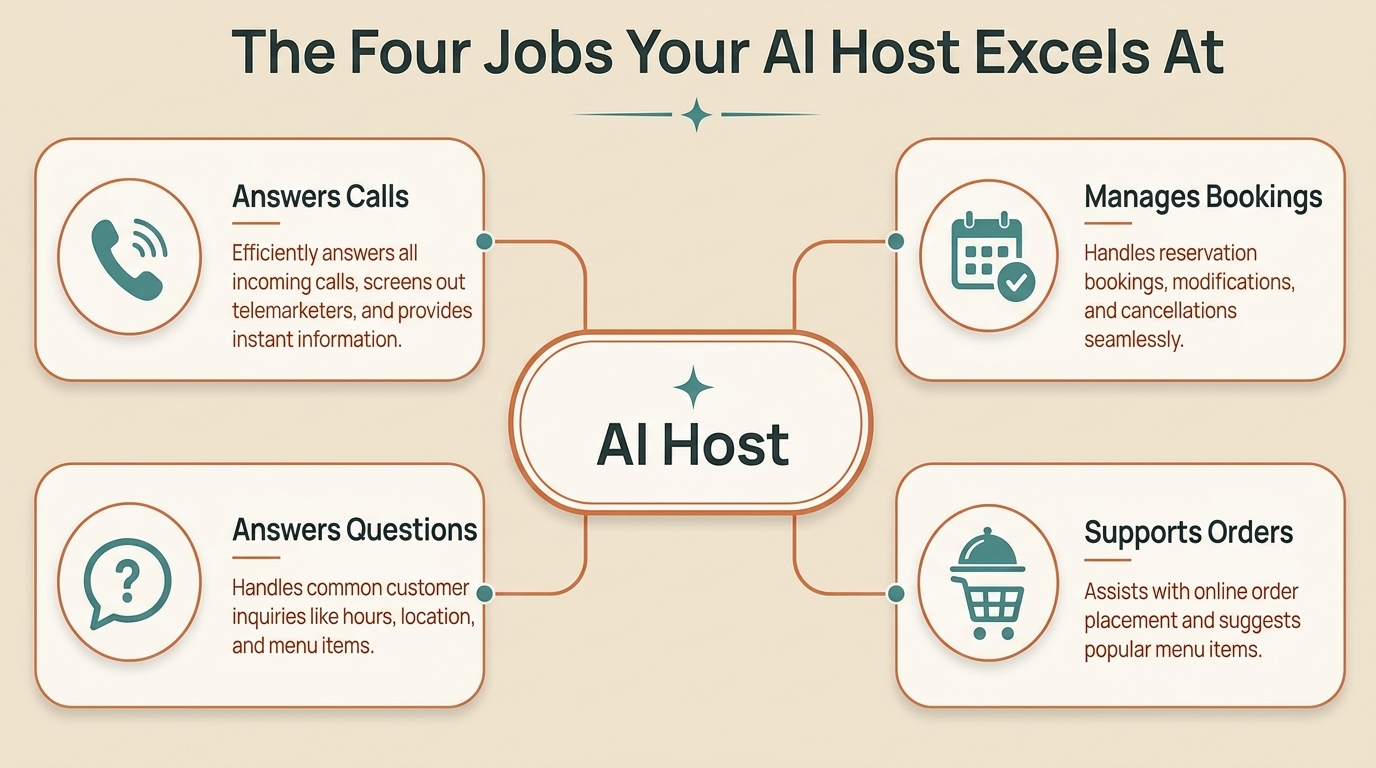
The smartest way to evaluate an AI phone answering system is to stop thinking about software and start thinking about job roles. In a restaurant, the phone creates four very specific kinds of labor. The right system handles all four.
Near the start of the call flow, this kind of structure matters most
Order taker without the panic
A real host under pressure can still make mistakes. They mishear a modifier. They skip a sauce choice. They forget to repeat the allergy note. None of that comes from bad effort. It comes from overload.
A hospitality-first AI host doesn't get overwhelmed by a caller who says, “Two pad thais, one no peanuts, one extra spicy, add chicken to both, and make one without green onions.” It listens, clarifies, and captures the details in sequence.
That matters because restaurant calls aren't clean little FAQ sessions. They're messy. They include half-decisions, special requests, and policy questions stuffed into the same conversation.
Concierge for repetitive calls
A shocking amount of phone volume has nothing to do with complex hospitality. It's the same set of questions over and over.
- Hours and holiday availability matter to callers who need a quick answer now, not after a hold.
- Location and parking details save staff from repeating directions during peak periods.
- Pickup timing and order status keep guests informed without dragging a manager onto the phone.
- Policy questions about reservations, large parties, or allergy accommodations can be handled consistently.
This is the easiest labor for AI to absorb, and restaurants should take that win immediately. Human staff shouldn't spend prime service time repeating information that can be delivered instantly and accurately.
Upsell specialist with perfect consistency
Most restaurants train upselling and then watch it disappear when the shift gets busy.
That's normal. A slammed employee defaults to speed, not suggestion. An AI host can be programmed to follow house rules every time. If a family meal should prompt desserts, or a sandwich order should trigger drinks and sides, the system can make those suggestions consistently and without sounding pushy.
The advantage isn't gimmicky sales language. It's disciplined execution. The same prompts get delivered the same way on every call.
Restaurants don't need aggressive upselling. They need reliable prompting at the right moment.
Traffic controller during rushes
This role gets overlooked, but it may be the most valuable one on chaotic nights.
A good AI phone answering system acts like a traffic controller for incoming demand. It handles easy calls automatically, identifies calls that need escalation, and keeps the queue from becoming one long line of frustrated callers. Some conversational AI phone systems are reported to understand natural speech with about 90 to 95% accuracy in some implementations, compared with roughly 60 to 70% keyword matching in traditional IVR, and they can manage 10+ back-and-forth exchanges while maintaining context.
For operators, the takeaway is simple. Modern voice systems can hold a real conversation long enough to solve routine calls instead of failing after the first unexpected phrase. That makes rush-hour triage possible. And when the system isn't confident, a handoff to staff is the right move.
Must-Have Features for Restaurant Operations
At 7:15 on a Friday, the phone is ringing, two guests are waiting to be seated, a delivery driver wants clarification, and the kitchen is already pushing tickets hard. In that moment, a generic business phone bot is useless. Restaurants need a phone system built for service pressure, menu precision, and the kind of details that decide whether an order goes out right or comes back angry.
That is the filter for every feature in this section. Judge it by what happens to the guest, the host stand, and the line.
Menu fidelity comes first
Start here. Nothing matters more.
Restaurant calls break down on specifics. Sauce on the side. No onion. Extra crispy. Swap fries for salad. Allergy note. Cutlery request. Late-night menu only. If the system misses those details, it does not save labor. It creates remakes, refunds, and stressed staff.
A restaurant-ready AI phone answering system must understand the actual menu and the rules behind it. That includes modifiers, substitutions, combos, item availability by daypart, add-ons, and house policies around allergies and special requests. It also needs to know when to stop and transfer the call because some situations should never be guessed through.
If a provider cannot show accurate order handling on your actual menu, do not buy it.
The Feature Checklist That Matters
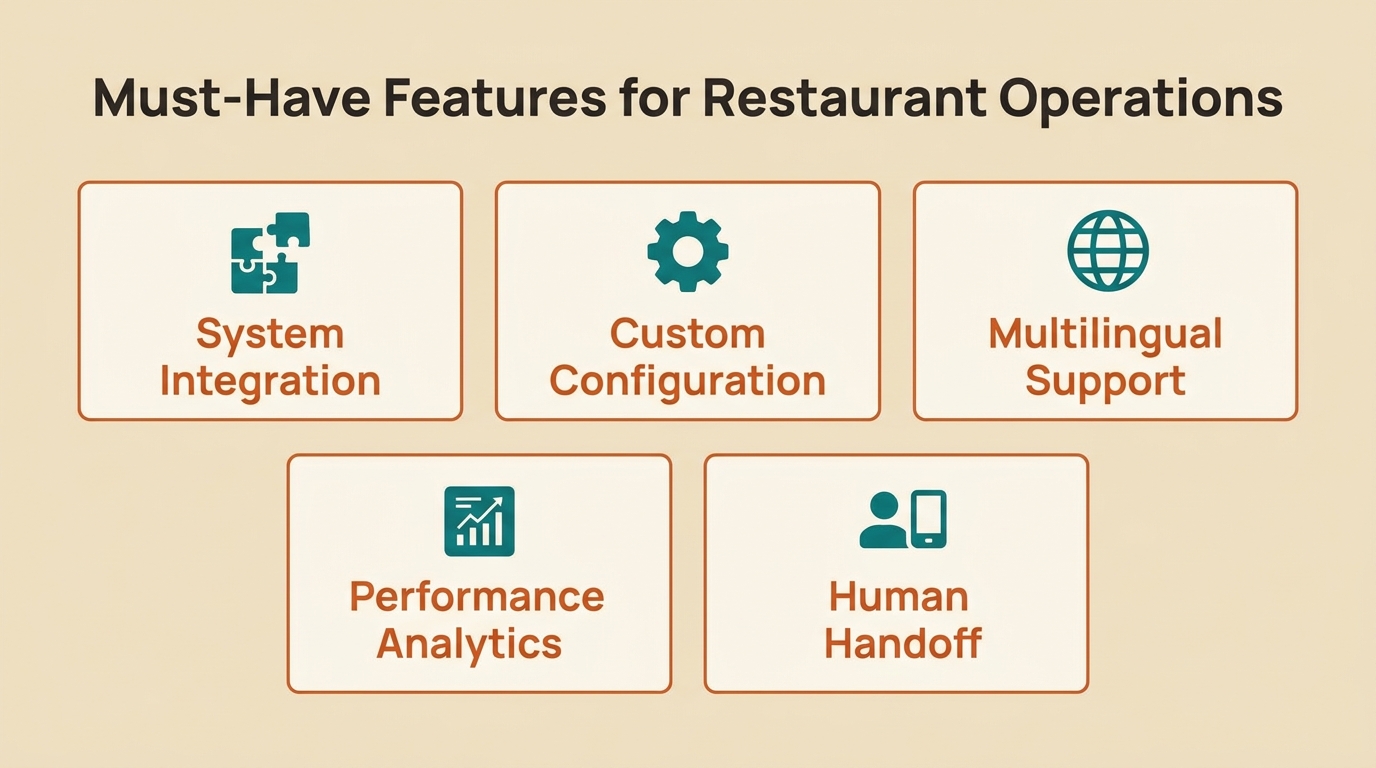
Look for features that reduce front-of-house pressure and protect kitchen accuracy:
- Menu-aware order capture that handles modifiers, spice levels, add-ons, exclusions, and house rules without forcing the caller into awkward phrasing.
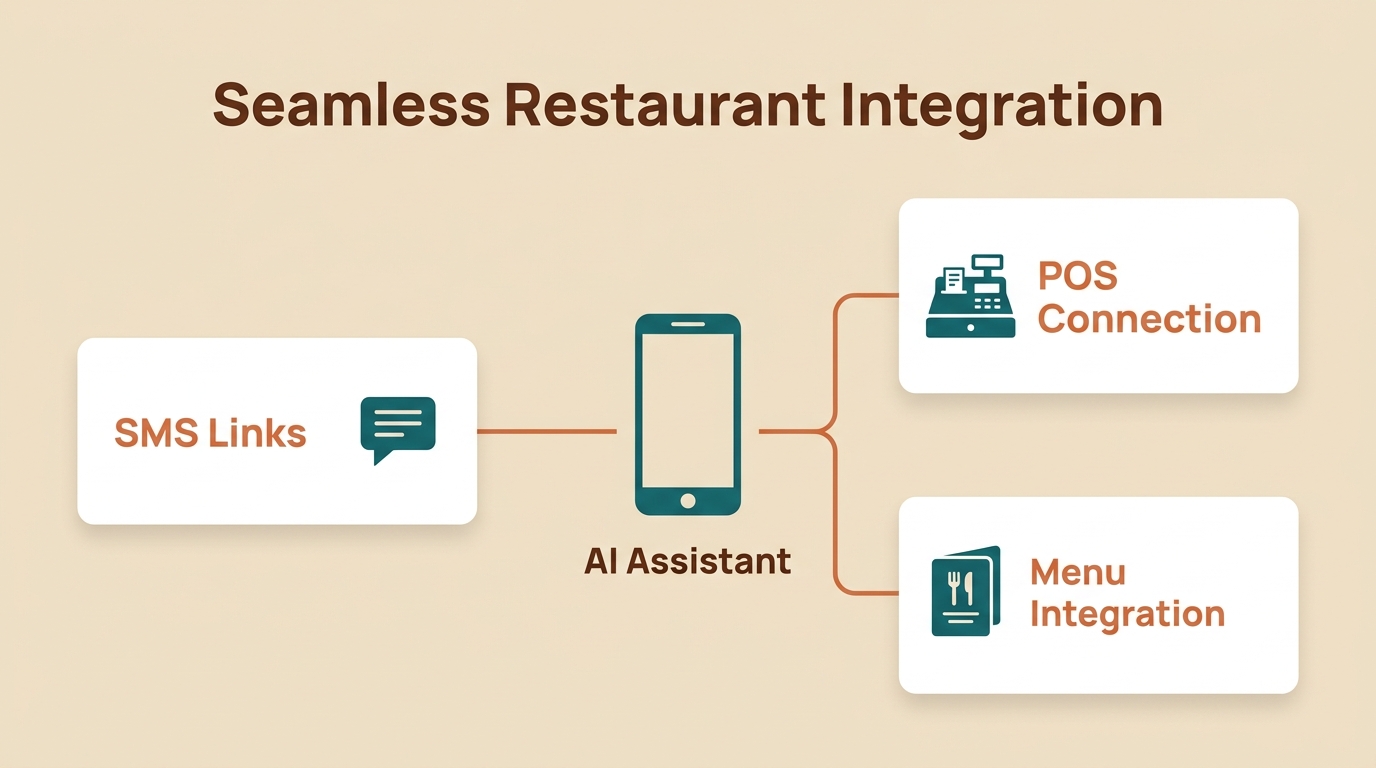
- POS and reservation integration so staff are not retyping orders, names, or booking details while the lobby fills up.
- SMS confirmations and payment links for takeout orders, prepay workflows, and fewer callback mistakes.
- Live handoff options for complaints, VIPs, large catering questions, allergy-sensitive situations, and anything else a manager should hear directly.
- Editable knowledge base for hours, holiday schedules, parking instructions, delivery boundaries, large-party policies, and other guest questions that tie up the host stand.
- Multi-location logic for groups that need the right menu, hours, and routing by store instead of one watered-down script.
- Call analytics that show which questions keep coming up, where calls fail, and which menu or policy gaps need to be fixed.
The best test is simple. Give the system a messy order and listen to how it handles it. If it can confidently manage "half sweet sauce, no pickles, add cheddar, sub onion rings, and make one gluten-free," you are looking at a tool built for hospitality. If it stalls, repeats itself, or drops details, keep shopping.
A service like TastyVox restaurant phone answering service fits this restaurant-specific category because it focuses on menu fidelity, takeout capture, common guest questions, and rush-hour call handling instead of generic office reception.
If the system sounds polished but cannot correctly handle "half sauce, dressing on the side, no cilantro," it will create more work than it removes.
Implementing Your New AI Team Member
Friday at 7:15 p.m., the host is quoting wait times, a server is running drinks, and the phone keeps ringing with pickup questions and modifier-heavy orders. That is the exact moment a bad rollout gets exposed. A restaurant AI phone system has to step in like a trained host on day one, or it becomes one more problem your team has to clean up.
Set it up the way you would onboard a strong front-of-house hire. Give it the complete menu, the established policies, and the critical edge cases that trip up service.
Start with four inputs
- Menu truth including modifiers, substitutions, add-ons, combos, sizes, sold-out items, allergy notes, and item names guests use.
- House policies for reservations, large parties, cancellations, catering, alcohol sales, delivery boundaries, and cutoff times.
- Call flows for takeout, curbside pickup, hours, directions, waitlist questions, and after-hours coverage.
- Escalation rules for complaints, refunds, VIPs, vendor issues, and anything a manager should hear directly.
If a vendor barely asks for this information, walk away. Restaurants are too specific for a generic office script. The whole point is hospitality-first accuracy. If the system cannot follow your menu and service rules, it will create remake costs, callback headaches, and frustrated guests.
Keep the rollout tight.
Use your existing phone number if possible so guests notice better service, not a change in process. Then test the system with real calls from your busiest windows. Use the ugly stuff, not the easy stuff. Try modifiers, sold-out items, split orders, allergy questions, and guests who change their mind halfway through. That is how you find out whether the AI can protect the shift instead of slowing it down.
Staff buy-in matters just as much as setup. Your team will accept this faster when you position it correctly. This is not a replacement for hospitality. It is the person who always picks up, never forgets the ranch on the side, and never leaves the phone ringing while the dining room gets slammed.
A clean launch usually includes a few simple rules
- Define live handoff moments so hosts and managers know exactly when to jump in.
- Train staff on the handoff so nobody freezes when a call needs a human.
- Collect bad transcripts and missed details during the first couple of weeks.
- Update menu and policy changes fast so the system stays accurate during specials, holiday hours, and limited menus.
If you are comparing providers, this restaurant phone answering service overview gives a clear picture of what should be configured before launch, especially around order flow, menu fidelity, and human takeover.
Start narrow. Let the AI handle routine guest questions, after-hours calls, and straightforward phone orders first. Once it proves it can protect accuracy during a rush, expand its role. That is how you install a reliable AI team member without turning the first week into a service recovery exercise.
Measuring Success Beyond a Quieter Phone
A quieter phone is nice. It isn't the main point.
The ultimate measure is whether the AI phone answering system improves revenue capture, reduces operational friction, and makes service more stable during peak periods. That requires tracking the right numbers, not just saying the restaurant feels less chaotic.
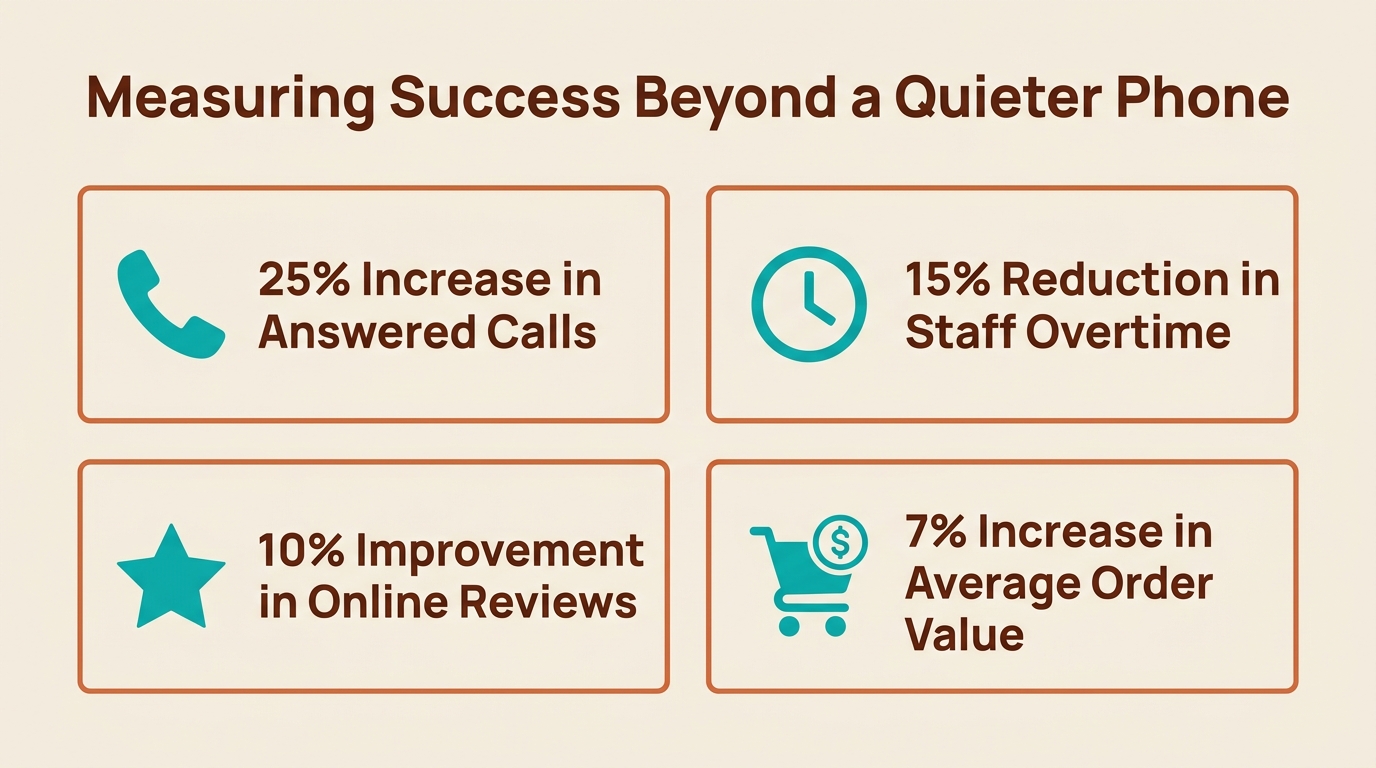
Track the numbers that change decisions
Restaurant operators should review a short scorecard every week
- Answered versus missed calls to see whether fewer callers are dropping before service begins.
- Takeout and delivery phone order volume to spot recovered demand that used to leak away.
- Average check movement on phone orders if the system is making structured upsell suggestions.
- After-hours captured demand for restaurants that close the line too early with traditional staffing.
- Transfer rate to staff so managers can see whether the system is solving routine calls or punting too many.
This category is no longer fringe. One 2026 industry survey reported that 34% of U.S. and European SMBs were using AI phone handling in Q1 2026, up from 11% in Q1 2024, roughly a 3x increase in two years. The same source reported 62% of Fortune 500 companies were using AI phone agents in at least one department. For restaurants, that means the question has shifted from “Is this real?” to “Is this configured properly for operations?”
Operators that still underestimate phone leakage should review how missed restaurant calls affect revenue capture, then compare those losses against current call handling during peak periods.
Watch the operational signals too
Not every important outcome shows up as a single line item.
A stronger phone process usually shows up in calmer host stands, fewer mid-service interruptions, and less stress on managers who used to get dragged into routine calls. Staff morale improves when employees aren't trying to host, answer phones, quote wait times, and explain parking in the same ninety-second stretch.
The best measurement is not “Did the phone ring less?” It's “Did the restaurant run better while calls were still being handled?”
That's the shift worth paying for.
Your Next Steps and Common Questions
Restaurants don't need to overthink this. If calls regularly hit voicemail, pile up during rushes, or create kitchen mistakes when staff rush through orders, an AI phone answering system deserves a serious look.
The key is choosing one built for restaurant reality. Menu fidelity matters. Human handoff matters. Integration matters. Hospitality matters.
Common questions from operators
Will guests hate talking to AI?Not if the system sounds natural, solves the issue quickly, and knows when to transfer. Modern conversational AI phone systems are reported to understand natural speech with about 90 to 95% accuracy in some implementations, compared with roughly 60 to 70% for traditional keyword-style IVR, and they can handle 10+ back-and-forth exchanges while keeping context.
What happens if the system gets confused?The right answer is escalation, not bluffing. A restaurant should insist on clear fallback behavior. If the call gets unusual, emotional, or operationally risky, a human should take over.
Is this right for every restaurant?No. A tiny operation with almost no phone demand may not need it yet. But busy takeout restaurants, multi-location groups, catering-heavy concepts, and any operation where the host stand gets buried by calls should treat this as an operational tool, not an optional extra.
What should an operator do next? Ask for a live demo using the actual menu, actual modifiers, and actual edge cases. If the provider can't handle those cleanly, move on.
Restaurants that want calmer shifts, fewer missed calls, and cleaner order capture can look at TastyVox as one hospitality-first option. It sits behind the existing number, answers calls around the clock, handles common questions, captures takeout orders, and routes tougher conversations to staff when needed.
How this was researched
This article draws on operator interviews, publicly available industry data, and TastyVox's experience working with independent restaurants. Figures cited are representative ranges; your restaurant's specifics will vary.
Want to hear what this sounds like in practice?
Listen to a demo call with a real restaurant menu. No commitment, no sales pitch.
See how TastyVox sounds with your menu.
Book a 20-minute call and we'll walk through how it works for your specific restaurant.