
Mastering Restaurant Reservation Management
Key Takeaways
- Treat the reservation book as a live capacity and service-pacing system, not simply a list of names.
- Keep online bookings, phone changes, walk-ins, table status, and guest notes in one source of truth.
- Turn cancellation, late-arrival, large-party, and table-hold policies into clear rules the host team can use during service.
- Review arrival clusters, turn-time reliability, no-show patterns, channel mix, and seat utilization every week.
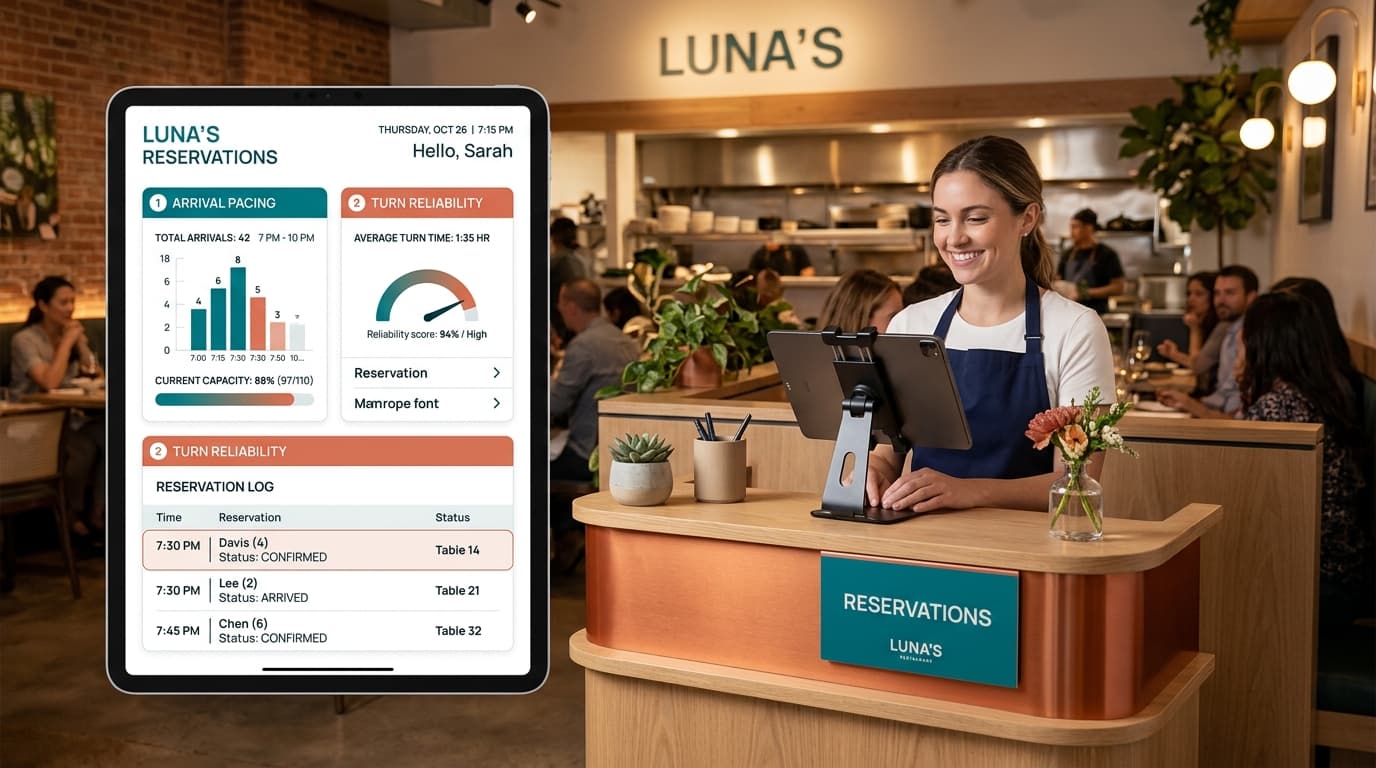
Why does reservation management become an operations problem during service?
Friday night fills up in layers. First come the early planners. Then the same-day diners. Then the callers who need to move a table from four to six, ask about patio seating, mention an allergy, or want to know whether a late arrival will still be honored. At 7:15, the kitchen slips a few tickets behind, two walk-ins are staring at an open-looking table that's spoken for, and the host stand starts making decisions that affect the whole room.
That's where restaurant reservation management stops being an admin task and becomes operations. The book isn't just a list of names. It's the control panel for pacing service, protecting guest experience, and defending margin when the night gets messy.
Most advice covers how to accept reservations. Far less covers how to manage them when demand, staffing, and service capacity change in real time, especially in restaurants that still handle plenty of reservation traffic by phone. That's the gap that matters on live service.
Beyond Bookings: The Business of Reservation Management
Restaurant reservation management used to mean keeping the book clean and getting guests to the right table. That's outdated. Modern systems function as revenue-management tools, and industry guidance now treats direct booking through a restaurant's own website, social profiles, and Google Business Profile as a way to increase seat utilization, boost guest spend, and reduce no-shows while avoiding third-party dependence and commissions.
A strong book behaves like air traffic control for the dining room. It controls flow, protects capacity, and helps the floor absorb disruption without turning every delay into a guest-facing problem.
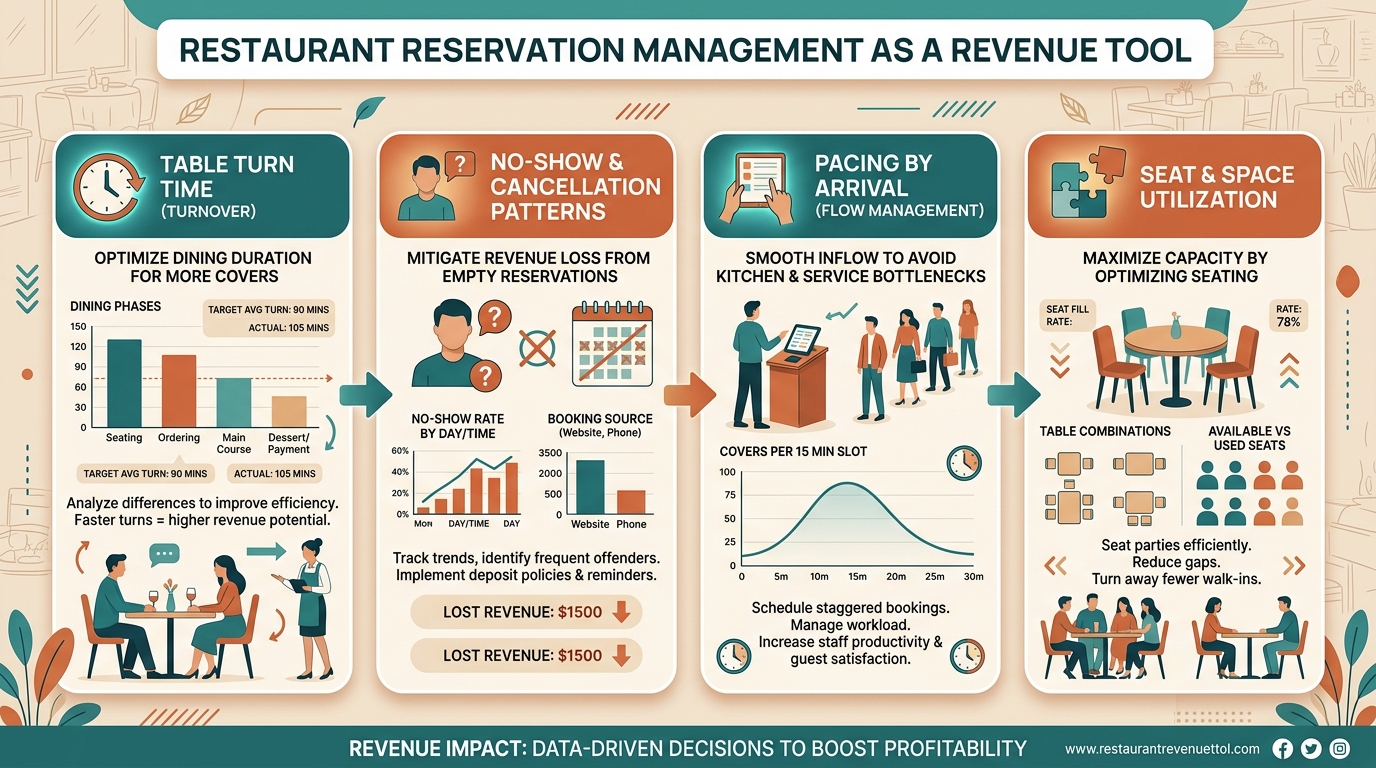
The reservation book is a profit tool
The biggest mistake operators make is treating reservations as demand capture only. Full books can still produce poor service, long waits, weak turns, and frustrated staff if bookings are accepted without regard to actual throughput.
What matters is whether the book supports the room the restaurant can realistically serve. That means looking beyond covers and tracking the operating measures that shape a shift:
- Table turn time helps the team understand whether a seating plan matches reality. If two-tops are lingering longer than the booking duration assumed by the system, later reservations are already at risk.
- No-show and late-cancel patterns reveal which slots and party sizes need more protection.
- Pacing by arrival window matters more than raw reservation count. Ten arrivals in one fifteen-minute burst can be worse than a slightly higher count spread over an hour.
- Seat utilization by service period shows whether prime inventory is being used well or clogged by poorly timed bookings.
- Guest notes and return history help the team make better seating choices, especially for allergies, accessibility needs, celebrations, and VIP recovery.
Practical rule: A reservation only has value if the kitchen, bar, and floor can absorb it without degrading the rest of service.
What to measure at the host stand
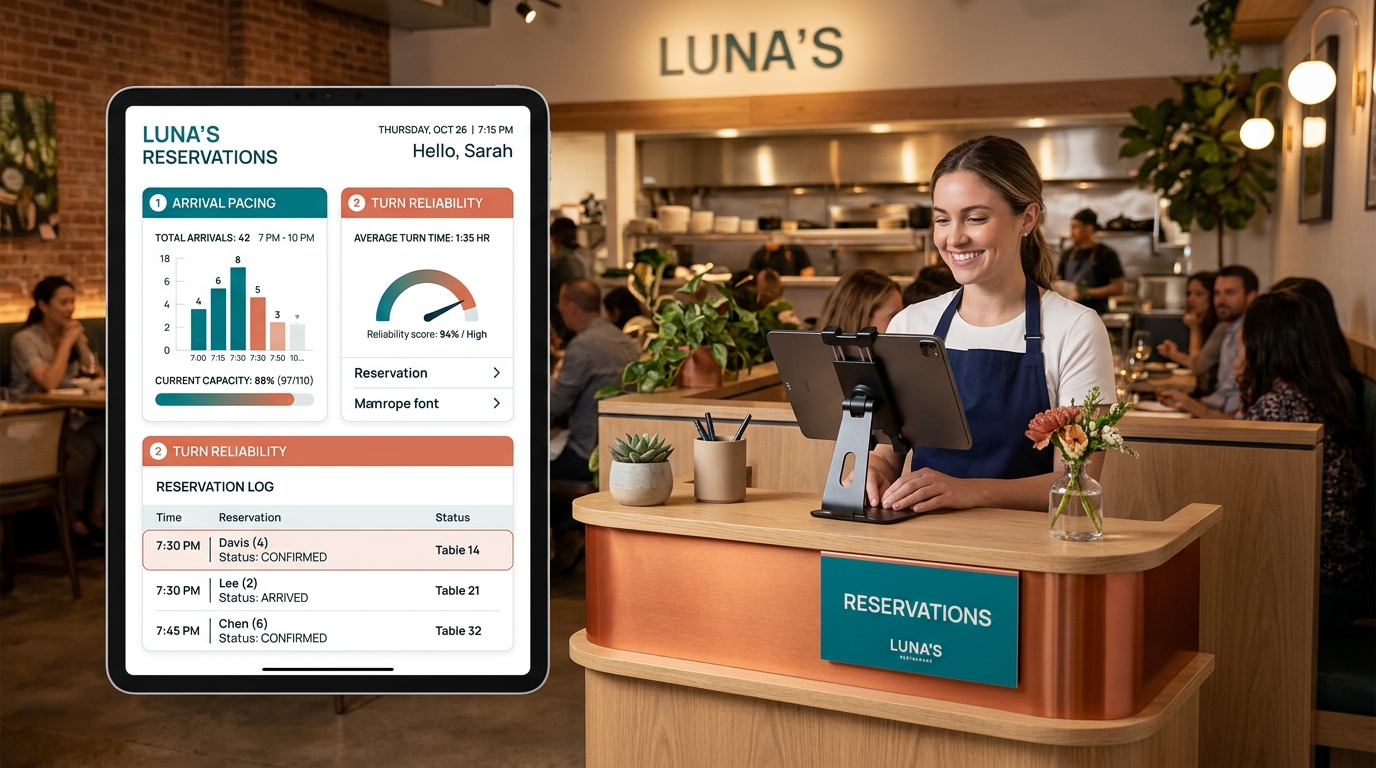
Operators often talk about RevPASH, turn time, and no-shows, but the host stand needs working versions of those ideas, not finance-language reports nobody checks during service. The useful version is simple: Which tables are late, which arrivals are bunching up, which parties are likely to dwell longer, and which bookings are flexible enough to move without creating a guest issue?
A small tracking table can make that visible fast
| Focus area | What the host team watches | Why it matters |
|---|---|---|
| Arrival pacing | Reservations by short time window | Prevents sudden pressure on kitchen and seating |
| Turn reliability | Actual vs planned table durations | Exposes overpromised inventory |
| Channel quality | Direct web, social, Google, phone | Shows where cleaner bookings come from |
| Recovery risk | Late parties, special requests, large groups | Helps managers intervene early |
When operators run restaurant reservation management this way, the host stand stops reacting and starts allocating capacity. That shift changes the economics of the whole shift.
Common Pain Points Every Operator Knows Too Well
The trouble usually starts long before anyone says the room feels slammed. It starts when the host is answering a ringing phone, checking in one party, quoting a wait to another, and trying to decode a note that says “maybe patio if weather okay.”
That's when small cracks turn into service problems.
The rush starts before the dining room is full
Reservation behavior has become harder to stage neatly. Tableo's 2025 reservation overview reports a 21% year-over-year increase in bookings and says 66% of reservations were made the same day. Because Tableo is a reservation vendor and the overview does not publish a full methodology on the page, treat those figures as a directional signal rather than a universal benchmark. For operators, the practical point is that the day's plan can keep changing right up to service.
A familiar sequence plays out.
A four-top no-shows at 6:30, so the host gives that table to walk-ins. At 6:40, a six-top calls to say they're parking. At 6:45, a two-top arrives early for a table that won't be free because the prior party hasn't closed out. Nothing is technically broken, but the room is already off rhythm.
What guests feel in that moment is simple. They feel uncertainty. The team feels it too. The host starts making one-off judgment calls. Servers get incomplete seatings. The kitchen sees uneven fire times. A reservation problem becomes a whole-house pacing problem.
Phone intake creates hidden coordination gaps
Online booking gets most of the attention, but plenty of restaurants still handle the hardest reservation moments by phone. That includes modifications, special requests, large parties, after-hours voicemails, allergy questions, and the urgent “we're running twenty minutes late” call that determines whether a table gets protected or released.
Those calls often hit at the worst possible times
- During peak check-in windows when the host should be controlling the door
- During pre-service setup when nobody wants to stop and answer nuanced questions
- After hours when interested guests can't get immediate confirmation
- During kitchen slowdowns when every seating decision needs tighter control
An unattended reservation call is not automatically a lost booking. It may be a missed change, a delayed recovery, or a duplicate entry waiting to happen.
The emotional cost is real too. Hosts end shifts feeling like they spent the night apologizing for problems that started upstream. Managers end up smoothing over delays that came from preventable intake chaos. Staff burnout often starts at the stand, not the line.
Designing Your Reservation Policies and Workflows
Policies shouldn't exist to sound strict. They should exist to make fair decisions repeatable under pressure. Good restaurant reservation management depends on that. If the team has to reinvent the answer every time a guest is late, asks for an exception, or pushes for a bigger party than the floor can handle, the policy is too vague to be useful.
Set policies that protect service
Every restaurant needs a written position on the basics. Not because guests love rules, but because inconsistency creates more friction than clarity.
A workable policy set usually includes
- Late arrival handlingDefine how long the restaurant will hold a table, who can extend that hold, and when the reservation converts to a waitlist or release decision.
- Large-party protectionUse firmer confirmation requirements for reservations that materially affect the floor. Large parties don't just take space. They change pacing, server load, and dwell time.
- Cancellation and modification windowsGuests should know what happens when they cancel late, cut a party size, or move the reservation into a more constrained time.
- Special-request standardsPromise what the team can control. Note preferences clearly, but don't guarantee patio, window, or exact table numbers unless the restaurant is prepared to honor them every time.
A policy is only good if the guest can understand it in one reading and the host can explain it in one breath.
Build decision rules for live service
Most generic guides stop too early. A key challenge isn't taking bookings; it's deciding what to do when service conditions change in real time.
Reservations are also a capacity-allocation problem, not just a booking tool. A peer-reviewed Cornell Hospitality Quarterly study used restaurant simulations to compare assigning tables at booking time with pooling reservations for real-time assignment. The researchers found that pooling enabled a 15-minute reduction in table turn time in more than 15% of simulated cases. That is not a guaranteed outcome for every dining room, but it supports testing flexible table assignment instead of locking every booking to a specific table too early.
A manager needs operating rules for moments like these
| Live situation | Better move | What to avoid |
|---|---|---|
| Kitchen is backed up | Slow new seating pace and quote honestly | Seating “because the table is open” |
| Host is short-staffed | Consolidate arrivals and simplify rotation | Taking every phone modification manually at the stand |
| Walk-ins surge | Protect booked inventory first, then release selectively | Giving away future reservations too early |
| Large party is late | Trigger a manager review before holding too long | Letting one delayed party derail multiple later turns |
Floor rule: Protect the shift, not just the next table. One aggressive seating decision can destabilize the next hour.
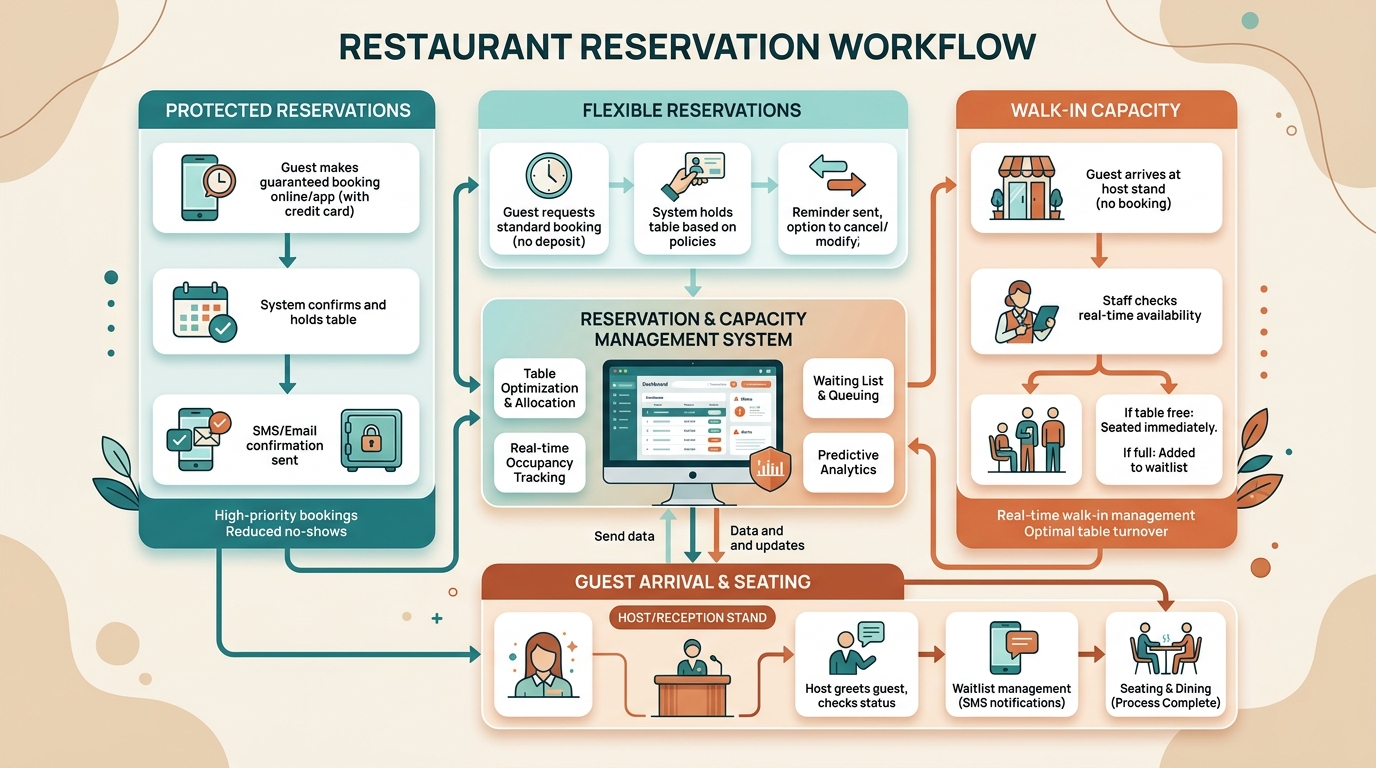
A useful service model separates three buckets of inventory: protected reservations, flexible reservations, and walk-in capacity. Protected reservations include high-value or hard-to-replace bookings. Flexible reservations can be nudged by a few minutes with clear communication. Walk-in capacity should exist, but it has to be intentional, not accidental.
Turn policy into a repeatable floor routine
The cleanest workflows usually look boring on paper. That's a compliment.
- Before service: confirm table mix, blocked inventory, large parties, special requests, and any known staffing constraints.
- At open: assign one person ownership of the live book. If everyone can edit everything, nobody owns pacing.
- During rush: review arrivals in short windows, not just “what's next.”
- At every disruption: ask whether the issue is temporary or structural. A five-minute delay doesn't require the same response as a kitchen bottleneck that's spreading.
Restaurants don't need more complexity. They need clearer thresholds for when to delay, cap, convert, and protect.
The Right Technology for Your Front of House
Technology should reduce host stand decisions, not multiply them. Plenty of restaurants buy reservation software and still end up running the room off handwritten side notes, callback lists, and memory. That usually means the stack doesn't match the operation.
What a reservation stack needs to do
The foundation is straightforward. The reservation system should capture bookings cleanly, display live inventory, and support the policies the restaurant uses. The next layer is integration.
Modern reservation systems work best when they connect directly to POS and CRM layers because the team can see live table availability, prevent double-bookings, attach guest notes and special requests to the reservation record, and automate confirmations and reminders.
That leads to a practical comparison
| Tool layer | What it solves | Where it falls short without integration |
|---|---|---|
| Online reservation platform | Captures self-serve bookings | Doesn't reflect floor reality fast enough |
| POS | Shows check status and table progress | Misses booking context and guest notes |
| CRM or guest profile layer | Stores preferences and history | Becomes passive if hosts don't see it during seating |
| Messaging automation | Sends confirmations and reminders | Can't handle exceptions or nuanced calls alone |
The goal isn't to add software for its own sake. It's to create one operating picture of the floor.
Online booking and phone handling must work together
This is the blind spot in a lot of setups. Restaurants push online booking, but the phone still handles complicated demand. That includes callers asking to combine reservations, move times, ask about children, split a large party, or book outside standard online rules.
For phone-heavy workflows, the practical gap is availability and follow-through, especially after hours. AI-assisted, 24/7 call handling can answer routine questions, capture reservation intent, and route exceptions without requiring the host to stop managing the door. Its value should be measured in response coverage, record accuracy, staff time, and completed workflows, not an assumed revenue figure for every unattended call.
That creates a clear choice for operators
- Online-only thinking works for simple self-serve demand, but it leaves edge cases to the busiest part of the shift.
- Phone-only habits preserve flexibility, but they create hold times, transcription errors, and inconsistent policy enforcement.
- A mixed-channel setup works better when both channels feed the same reservation logic and guest record.
One option in that mixed-channel model is a restaurant virtual receptionist that sits behind the existing number, handles reservation-related calls and common questions around the clock, and routes details back into the operation so the in-house team isn't juggling every inbound call during service.
The test for any tool is simple. If it creates duplicate work for the host, it's not helping.
Training Your Team to Be World-Class Hosts
Even a clean policy and a strong tech stack can fail at the stand if hosts sound hesitant, inconsistent, or defensive. Guests don't hear “workflow problem.” They hear confidence or uncertainty.
Scripts matter when the room is tense
Hosts need language that's warm, short, and firm. Long explanations usually make a policy sound negotiable.
A few examples work well
“The table is being held right now, and the team can honor it within the grace window. If timing changes further, the host stand will update the options immediately.”
That script protects the reservation without sounding punitive.
For a full night, this is stronger than an apology spiral
“The dining room is fully committed at the moment. The host can add your party to the waitlist and text as soon as a realistic opening appears.”
For cancellations and no-show protections, clarity beats softness
- When explaining the rule: “The policy is attached during booking and confirmation so the team can hold that inventory fairly.”
- When offering an alternative: “If the timing is uncertain, an earlier or later slot may be safer than risking a rushed arrival.”
- When taking special requests: “The request will be added to the reservation. The team will do its best, but it won't promise a specific table unless that option is guaranteed.”
Train hosts to protect both policy and warmth
The strongest hosts aren't gatekeepers. They're translators between guest expectations and operational reality.
Training should cover more than button clicks. It should include role-play for late arrivals, oversized parties, walk-in pushback, and high-stress phone calls. It should also teach hosts to spot opportunities. A reservation call often reveals celebration details, accessibility needs, dining pace, and preference cues that make service smoother later.
A useful staffing question also sits underneath all this. Is the operation short on labor, or is the team spending too much time on repetitive intake? Operators weighing that trade-off can use this piece on whether to hire another host or get AI to think through the decision in practical terms.
Strong hosts do three things consistently
- They confirm the important details. Time, party size, contact info, special requests, and any policy that affects the booking.
- They set expectations without friction. Guests are less likely to argue with a rule they heard early and clearly.
- They protect the room. They know when “yes” hurts service and when a better alternative preserves both revenue and goodwill.
Your Restaurant Reservation Optimization Checklist
A reservation book falls apart in small ways before it blows up in obvious ones. Tuesday's sloppy notes become Friday's seating delay. One host promising a 15-minute grace period while another enforces 10 turns a simple late arrival into a front-door argument.
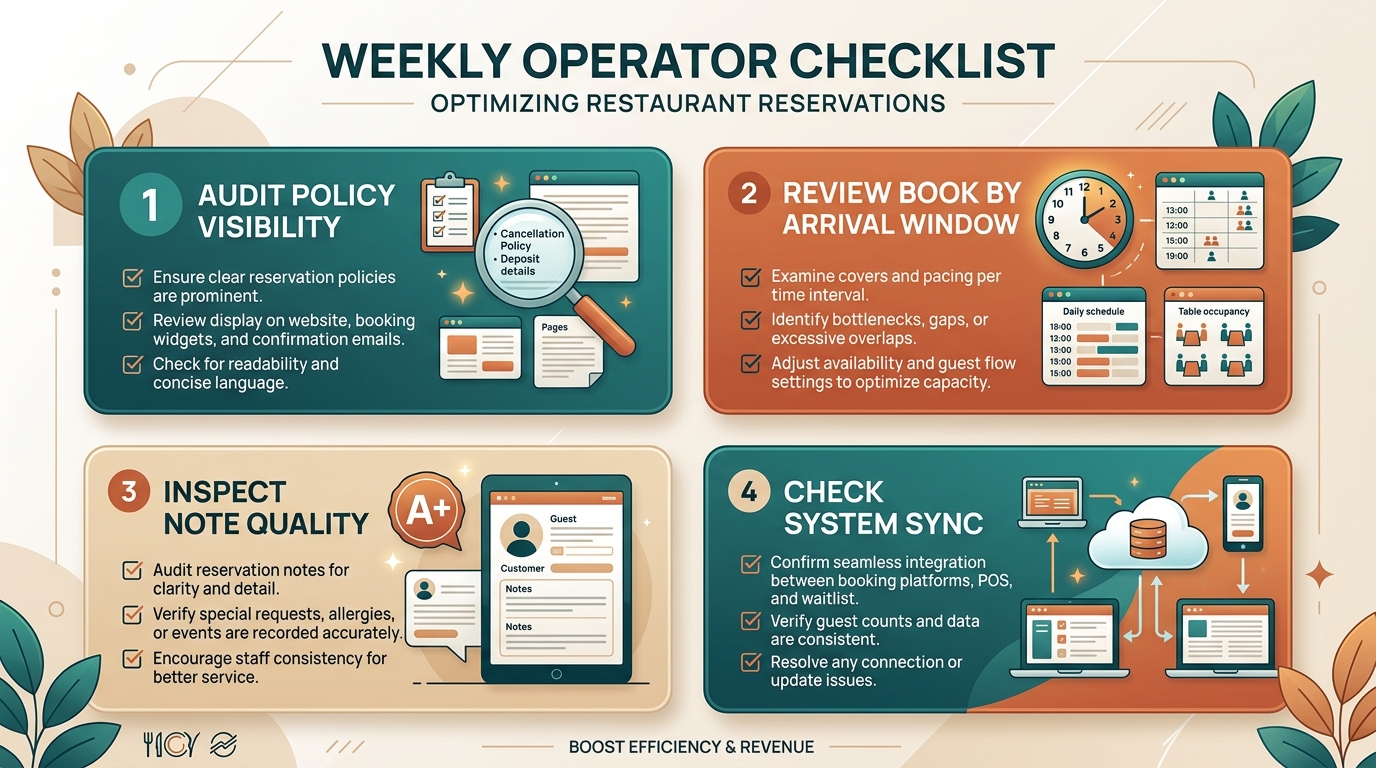
A weekly operator checklist
This review should take one manager less than an hour. If it takes longer, the process is too complicated or the team is leaving too much unresolved during service.
- Audit policy visibility. Check the website, booking flow, confirmation messages, voicemail, and host scripts. Guests should hear the same answer whether they book online or call during the dinner rush.
- Review the book by arrival window. Total covers can look healthy while 7:00 to 7:30 is overloaded and 8:15 is empty. That is where waits, rushed turns, and kitchen pressure start.
- Inspect note quality. Good notes help the next person act fast. Weak notes force the team to re-ask basic questions, miss special occasions, or seat a party without context.
- Check system sync. Reservation details, table status, and guest records should match across the tools the team uses. If hosts are flipping between screens or keeping backup notes on paper, the setup is creating risk.
- Review last week's friction points. Pull late arrivals, no-show disputes, duplicate bookings, and seating conflicts. The goal is not to find blame. The goal is to find repeatable failure points.
- Test phone coverage. Call during prep, during peak service, and after hours. Listen to what a guest hears, how long it takes to get help, and whether the call flow protects the book or creates more cleanup for the host stand.
Phone-heavy restaurants should treat that last check seriously. A reservation system is only as good as its intake, and intake still happens by phone in many dining rooms. If calls are left unattended, get scribbled on paper, or sit in a voicemail box until after service, the reservation book is already incomplete.
What changes for independents and multi-location groups
Independent operators usually win with fewer rules, enforced well. One source of truth, clear pacing by table type, firm late-arrival handling, and dependable phone coverage will beat a complicated setup that nobody follows.
Multi-unit groups have a different problem. Standardization matters, but copy-paste rules can hurt performance. A 40-seat neighborhood bistro, a high-volume brunch unit, and a polished steakhouse should not run identical turn times or hold strategies just because they share ownership.
A useful split looks like this
| Operator type | Priority | Watch-out |
|---|---|---|
| Independent restaurant | Clean intake and simple rules | Too many exceptions handled from memory or sticky notes |
| Multi-location group | Shared standards with unit-level adjustments | Forcing the same pacing and booking rules on very different dining rooms |
The strongest reservation operations treat the book as a live control system. Hosts adjust to call volume, table status, kitchen pace, and actual arrivals in real time. That is the difference between a reservation list that looks organized at 3:00 p.m. and a front door that stays under control at 7:15 p.m.
TastyVox fits that operating reality for restaurants that still lose time and bookings on the phone. It's a hospitality-first phone AI for restaurants that answers through the existing number, handles common guest questions, captures reservation and order intent around the clock, and routes information where the team needs it so staff can stay focused on the guests in front of them. For operators reviewing their call flow alongside reservation workflow, TastyVox is worth a look.
How this was researched
Tableo's 2025 overview is used for its reported booking-growth and same-day reservation figures and is identified as vendor-published data. The operational finding about pooled reservations comes from a peer-reviewed Cornell Hospitality Quarterly study. Recommendations elsewhere in the guide are presented as operating practices, not guaranteed performance claims.
Want to hear what this sounds like in practice?
Listen to a demo call with a real restaurant menu. No commitment, no sales pitch.
Frequently asked questions
What is restaurant reservation management?
Restaurant reservation management is the process of matching bookings, walk-ins, table inventory, turn times, and live service capacity. The goal is to pace arrivals and protect the guest experience while using the dining room efficiently.
How can a restaurant reduce reservation no-shows?
Use clear cancellation terms, automated confirmations and reminders, accurate guest contact details, and deposits when the concept and party size justify them. Track patterns before changing policy so the response fits the actual problem.
How should phone and online reservations work together?
Both channels should update the same reservation record. Phone changes, special requests, and cancellations need to reach the same source of truth as online bookings so hosts do not reconcile separate lists during a rush.
Which reservation metrics should restaurant operators track?
Start with arrivals by time window, average and variable turn times, no-show and cancellation patterns, booking source, wait times, and seat utilization. Review the numbers alongside staffing and kitchen capacity.
See how TastyVox sounds with your menu.
Book a 20-minute call and we'll walk through how it works for your specific restaurant.