
Direct Phone Ordering vs. Delivery Apps: The Margin Math Every Operator Should Run
Key Takeaways
- Third-party delivery apps charge 15–30% per ticket. On a $40 takeout order, that is about $10 of margin out the door before food cost.
- Across 200 takeout orders a month, the commission gap is roughly $2,000 in margin, per location, every month.
- Pulling a server off the floor to answer the phone costs you twice: the dropped table service AND the rushed, error-prone order they take. The average restaurant misses 10–30% of phone calls during peak hours.
- The lever is structural, not motivational: shift takeout demand back to your direct phone line, then make sure the phone actually gets answered.
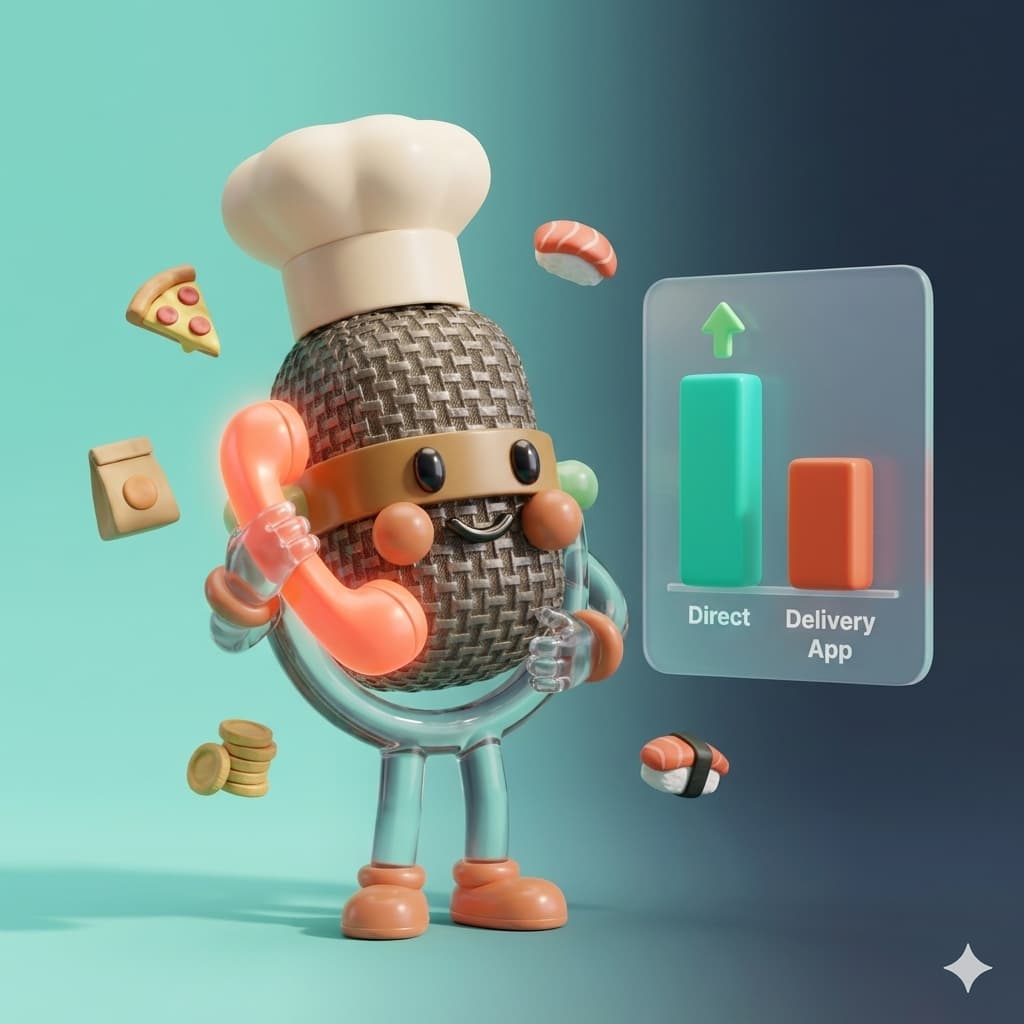
What does a delivery-app order actually cost the kitchen?
Operators see gross sales on the marketplace dashboard and feel busy. The take-home number is what matters.
Here is the simple math on a $40 takeout ticket, run two ways
Do that across 200 takeout orders a month and the gap is roughly $2,000 in protected margin per location, per month, about $24,000 a year, with zero new labor on the line. For a three-location operator running the same volume, the gap is $72,000 a year. For a takeout-heavy pizza shop running 400 phone-eligible orders a month, the gap doubles to $48,000 a year per location.
For perspective: $24,000 a year is more than most small independents spend on their entire annual marketing budget. It's roughly what a quarter-time FOH headcount costs. It's the difference between making payroll comfortably and squeezing it at the end of the month. None of that is food cost, your kitchen is producing the same plate. None of it is labor, your team is doing the same work. The entire leak is the channel the order arrived through.
Want to see your real number? Try our DoorDash Fee Calculator with last month's volume.
What does it cost when your team picks up the phone?
The instinct is: it's free, the host is right there, just answer it. The real number is not free.
Restaurant phones don't ring uniformly across the day. They cluster in the same two-hour windows where every minute of staff attention is already spoken for, the Friday 6:30 to 8:30 p.m. window, the lunch rush from 11:30 to 1:00. Asking a slammed host to "be better on the phone" is asking them to be in two places at once.
The predictable failure modes
- Voicemail dump. The caller hangs up and orders from a competitor or a delivery app within sixty seconds. That's where the 15–30% commission story starts.
- Long hold. The caller stays on hold, gets annoyed, and either bails or arrives in a bad mood, affecting tip and re-visit probability.
- Rushed half-take. The order is taken but the modifier is missed. Kitchen produces a remake. Comped meal. Bad review.
- Manager pulled from the pass. The expo line stalls because the only person who could answer the catering question is now on a four-minute phone call.
Picture it on the floor. A server takes a four-minute phone order at 7:12 p.m. on a Friday. The four-top they just sat at 7:10 hasn't seen a drink menu. The walk-in couple at the door is now waiting on the hostess who's covering for them. The line cook plates a dish for table two that nobody's there to run. The order they take gets the wrong modifier because they're trying to listen and watch the floor at the same time. Every minute of phone time costs minutes of dining-room service, and the dining-room minutes are the ones that determine whether the table tips 18% or 22%, whether the walk-in gives you a 5-star review or a 3.
Math it out. A $20/hour FOH server taking phone orders for 30 minutes during the dinner rush isn't a $10 cost, it's the dropped table service while they're on the call, the rushed order they fumble, and the regulars at table four who notice that their server keeps disappearing. Across a five-night week, even modest assumptions put that at $150–$300 a week of operational drag, $7,800–$15,600 a year, before you count the commission-app orders the missed calls turned into.
And here's the part that compounds: next time the regular who tried to call you on Thursday and reached voicemail picks up their phone, they open DoorDash. After two or three of those, calling you stops being a habit at all. You've trained your most valuable customers to use the channel that costs you the most.
What is the actual annualized hit?
Three leaks, compounding.
Leak one, commission paid on the bounced calls. Every call your team misses that ends up on DoorDash costs you ~$10 of margin on a $40 ticket. If you're missing 10 calls a day (the low end of the 10–30% miss rate at peak), that's $100/day, $3,000 a month per location, just in commission you didn't have to pay.
Leak two, operational drag from the calls you do answer. Every call your team picks up pulls them off the floor. The shift gets less attentive, table service slips, ticket times stretch. That's the $150–$300/week math above, $7,800–$15,600 a year of operational cost that doesn't show up as a line item anywhere.
Leak three, regulars lost to voicemail, compounded. This is the leak operators consistently underestimate, because it doesn't show up in any weekly report. A regular ordering 4x a month at a $35 ticket is $140/month, $1,680/year of recurring revenue. Lose five such regulars to voicemail-then-DoorDash over six months and you're looking at $8,400/year off the customer-count line, every year, compounding, because the regular doesn't come back once the new habit is set.
There's a reputational tail to leak three as well. A 1-star Yelp or Google review that says "tried to call, nobody answered, gave up" doesn't just cost you the one customer, it costs you the future first-time customers who read that review and pick a different place. That's harder to dollar-quantify, but every operator has watched it happen to a competitor down the street and felt grateful it wasn't them.
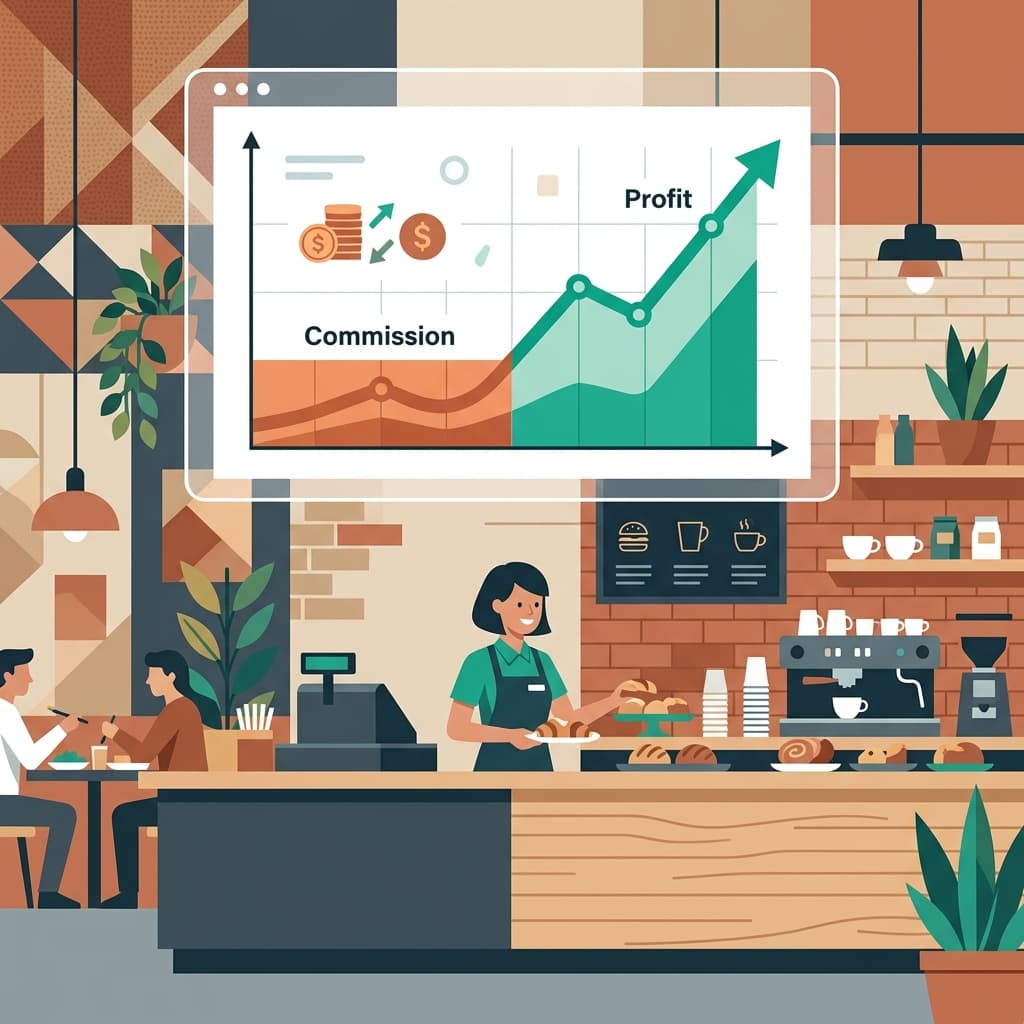
Stack the three leaks honestly: commission paid ($3,000/mo) + operational drag ($600–$1,200/mo) + regulars lost (compounding) and the annualized hit for a typical independent is somewhere between $50,000 and $90,000 a year per location. You don't see it on the P&L because it shows up across food cost (remakes), labor cost (overtime to cover slipped shifts), and the gap between projected and actual sales (regulars walking).
The lever: and the trap to avoid
The structural move is simple to describe: shift takeout demand back to your direct phone line so you stop paying commission, then make sure the phone actually gets answered so the regulars stay regulars.
The trap to avoid is solving the second half by hiring another host or expecting your existing team to "just do better." Hiring a dedicated phone host is roughly $3,000–$4,500/month fully loaded, and they still go home at 9 p.m. while late-night catering inquiries hit voicemail. AI phone answering, which is what we build at TastyVox, handles unlimited concurrent calls, doesn't pull anyone off the floor, and runs your house upsell on every single order. Pricing starts at $99/mo per location, so the math against either commission leakage or a new hire is straightforward.
The bottom line
Two things are true at the same time
Delivery apps will keep skimming 15–30% off every order they touch, that's the deal, and renegotiating it isn't on the table for an independent operator. And the phone, which costs you nothing per order, will keep ringing during the exact two hours when nobody on the floor can answer it.
The arithmetic doesn't change with the operator profile, only the size scales. A takeout-heavy pizza shop running 400 phone-eligible orders/month is looking at $4,000/mo, $48,000/yr of protected margin from the channel shift alone. A full-service restaurant running 100 phone orders/month still has $1,000/mo, $12,000/yr sitting unrecovered, smaller relative to a higher check average, but it's pure margin, not gross revenue. A three-location group at the original 200-order benchmark is leaving $72,000/yr on the table.
Over a five-year operating window, a single-location takeout-heavy operator stands to recover $120,000–$240,000 in cumulative margin just from the channel shift, before you count what gets added back when you stop bleeding regulars and stop paying for the operational drag of staff-on-phone.
The phone is not a distraction. It is the cheapest, highest-margin channel a restaurant owns, and the only customer-acquisition channel where a third party doesn't get a vote on your margin. The operators winning the next five years are the ones who treat it that way, protect the channel, protect the regulars, and stop subsidizing the marketplaces with kitchen-cost margin you can't get back.
How this was researched
Commission ranges reflect publicly disclosed merchant agreements for DoorDash, Uber Eats and Grubhub. The 10–30% missed-call benchmark is consistent with operator call-log analysis published by GoTab and reporting from QSR Magazine and the National Restaurant Association's 2025 State of the Industry Report. Worked dollar figures use a $40 takeout ticket and 30% food cost, substitute your own averages to get your specific number.
Want to hear what this sounds like in practice?
Listen to a demo call with a real restaurant menu. No commitment, no sales pitch.
Frequently asked questions
How much do third-party delivery apps actually cost?
DoorDash, Uber Eats, and Grubhub publicly disclose commission tiers in the 15–30% range, plus payment processing on top. On a $40 ticket that's about $10–$13 off the top, before you cover your food cost.
Is the missed-call cost really that bad?
Operator call-log studies typically find 10–30% of inbound calls go unanswered during peak hours. The worst part isn't the immediate lost order, it's the regulars who get voicemail twice in a row and stop trying. That shows up as customer-count drift in your trend report six months later, not as a weekly revenue dip you can spot.
Can't I just hire someone to answer the phone?
You can, a dedicated phone host runs roughly $3,000–$4,500/month fully loaded with benefits, training, and turnover. They handle one call at a time, take breaks, and go home at 9 p.m. while late-night catering inquiries hit voicemail. Compare that against an AI phone answering system at $99+/month that runs 24/7 and handles unlimited concurrent calls.
How do I shift takeout demand from apps back to my own phone line?
Receipt callouts, menu callouts, signage at the counter, an updated Google Business Profile that surfaces your phone number, and proactive 'next time, call us direct for X% off' inserts in marketplace bags all work. The structural part is making sure the phone gets answered when those callers do call, otherwise you're sending traffic to voicemail.
See how TastyVox sounds with your menu.
Book a 20-minute call and we'll walk through how it works for your specific restaurant.