
California Restaurant Show 2026: 7 Questions to Ask Before Buying Restaurant AI
Key Takeaways
- Restaurant AI is not one category. Voice, video, forecasting, loyalty, marketing, robotics, and workflow automation require different inputs and success measures.
- Not every “smart” restaurant platform is AI. Conventional automation can be valuable, but buyers should ask what predicts, generates, learns, or acts.
- The system of record matters more than the demo. Menu, POS, camera, customer, labor, and inventory data must stay accurate and auditable.
- A pilot needs baseline metrics and a stop rule. Measure resolved work, accuracy, guest impact, operator effort, and total cost.
- The final outcome is hospitality and consistency. Technology should make standards easier to repeat while freeing people to exercise care and judgment.
What did the 2026 California Restaurant Show reveal about restaurant AI?
The most important AI conversation at the 2026 California Restaurant Show did not happen in a product demo. It happened in the space between the booths and the education sessions.
On the show floor, vendors demonstrated voice AI, video intelligence, back-of-house forecasting, loyalty tools, creator marketing, booking systems, robotics, and plenty of software described simply as “smart.” In the sessions, restaurant operators kept returning to more durable ideas: communication, consistency, accountability, hospitality, and the systems that let an owner work on the business instead of spending every day trapped inside it.
I attended the show in Anaheim from August 23 to 25, spoke with the vendors discussed below and with most of the restaurant voice-AI companies exhibiting, and attended sessions on legacy restaurants, management, hospitality, and operational efficiency. TastyVox also builds restaurant voice AI, so this is not a neutral “best vendor” ranking. It is a buying framework: the questions I would want an operator to ask us and every other AI company before signing a contract.
No vendor paid for or sponsored inclusion in this coverage.
Did the 2026 California Restaurant Show feel smaller?
Several attendees I spoke with said the show felt smaller than the Los Angeles Convention Center years. The aisles and traffic did not carry the same scale some longtime attendees remembered.
A comparable post-show attendance total for 2026 has not been published. A show-produced release carried by Perishable News said more than 7,000 industry professionals were registered and cited 340+ exhibit booths, including 110+ new exhibitors. That booth figure uses a different unit from the 274 exhibiting companies in the official 2026 directory, compared with 237 exhibitors in the 2025 directory. Booths count physical exhibit spaces; the directory counts exhibiting companies.
For earlier context, the organizer reported more than 7,000 registrants in 2025 and nearly 5,000 industry professionals in 2024 at the Los Angeles Convention Center.
What kinds of restaurant AI were actually represented?
“Restaurant AI” is not one product category. At the show, it covered several jobs that use different inputs, integrations, and success measures.
| Category | Examples from the show | What an operator should evaluate |
|---|---|---|
| Guest and voice intake | Loman, TastyVox | Intent coverage, answer accuracy, callback/SMS/ticket routing, manager transfers, latency, and simultaneous-call performance |
| Video intelligence | Solink | Camera compatibility, POS correlation, alert quality, search speed, retention, and privacy controls |
| Back-of-house intelligence | Marble | Inventory truth, demand forecasting, purchasing, scheduling, approvals, and accounting/POS connections |
| Customer and loyalty intelligence | Curate | Customer-data ownership, direct-ordering integrations, segmentation, campaign controls, and attribution |
| Creator and local marketing | TryNearby | Creator fit, content rights, measurement, operational effort, and repeatability |
| Venue and private-event workflow | KneesUp | Availability, booking rules, payments, reporting, and administrative time saved |
Marble publicly describes an AI-native back-of-house operating system with inventory counting, forecasting, scheduling, procurement, and document extraction. Solink explicitly offers video intelligence for restaurant operations and security. Curate combines branded ordering, loyalty, marketing, and an AI interface for asking questions about restaurant data.
TryNearby publicly describes a creator marketplace that connects restaurants with local content creators. KneesUp describes venue discovery, booking, payments, and operational automation. Those may be useful restaurant technologies, but their public product pages do not establish that AI is the core product.
For an operator, the label matters less than the mechanism. Ask whether the product predicts, generates, learns, or follows pre-set rules. Conventional workflow automation can be extremely valuable; it should simply be evaluated for what it actually does.
That leads to the first buying question.
1. What operating problem should change?
Start with the shift, not the software.
Is the team leaving the phone unattended during service because many calls are routine questions? Is a manager spending four hours reconciling invoices? Are drive-thru times inconsistent? Are event inquiries stuck across email threads? Is the marketing team unable to identify returning guests? Is food preparation based on intuition because demand data arrives too late?
An unanswered restaurant call is not automatically a lost order. Depending on the concept, phone orders may represent only a small share of sales, while a meaningful share of call volume may consist of questions about hours, directions, parking, menus, reservations, allergens, order status, or private events. The honest starting point is the restaurant's own call log and intent mix. Do not assume that every ring represents demand.
DoorDash's 2026 Restaurant Industry Trends Report adds useful demand context. In Dynata surveys conducted for DoorDash in March 2026, 75% of 3,001 U.S. consumers said they were comfortable using AI for reservations, while 28% of 509 restaurant operators said they use AI to manage calls and customer service. The report also found that 22% of consumers had used an AI tool such as ChatGPT or Google Gemini to choose a restaurant. These are different measures from different respondent groups, not a direct 47-point adoption gap. Together, they show that AI is entering restaurant discovery and guest service while operator deployment remains less common.
A useful vendor should be able to turn the problem into a baseline and an observable outcome:
- Voice: call-intent mix, answer accuracy, approved intents resolved, staff interruptions avoided, and correct routing when a person needs to respond.
- Video: time spent reviewing footage, alert precision, service bottlenecks, or loss events investigated.
- Back office: forecast error, inventory-count time, purchasing corrections, food waste, or schedule edits.
- Marketing: direct-order conversion, repeat visits, attributable revenue, or campaign opt-outs.
- Events: response time, booking conversion, double-bookings, administrative touches, or payment lag.
The official description for the AI panel, “The New Agentic Hospitality OS,” framed the discussion around ROI, integration hurdles, pilots, and implementation. That is the correct frame. “We want AI” is not a business case. “We want routine guest questions answered consistently without pulling staff away from service” is.
2. What is genuinely AI, and what is conventional automation?
The distinction is not academic. It changes what can fail, how it should be monitored, and what evidence the vendor owes you.
Ask the company to describe which parts of its system
- Follow fixed rules configured by the restaurant.
- Predict an outcome such as demand, labor need, or risk.
- Generate language, recommendations, or actions.
- Learn or adapt from additional data.
- Require human approval before writing back to an operating system.
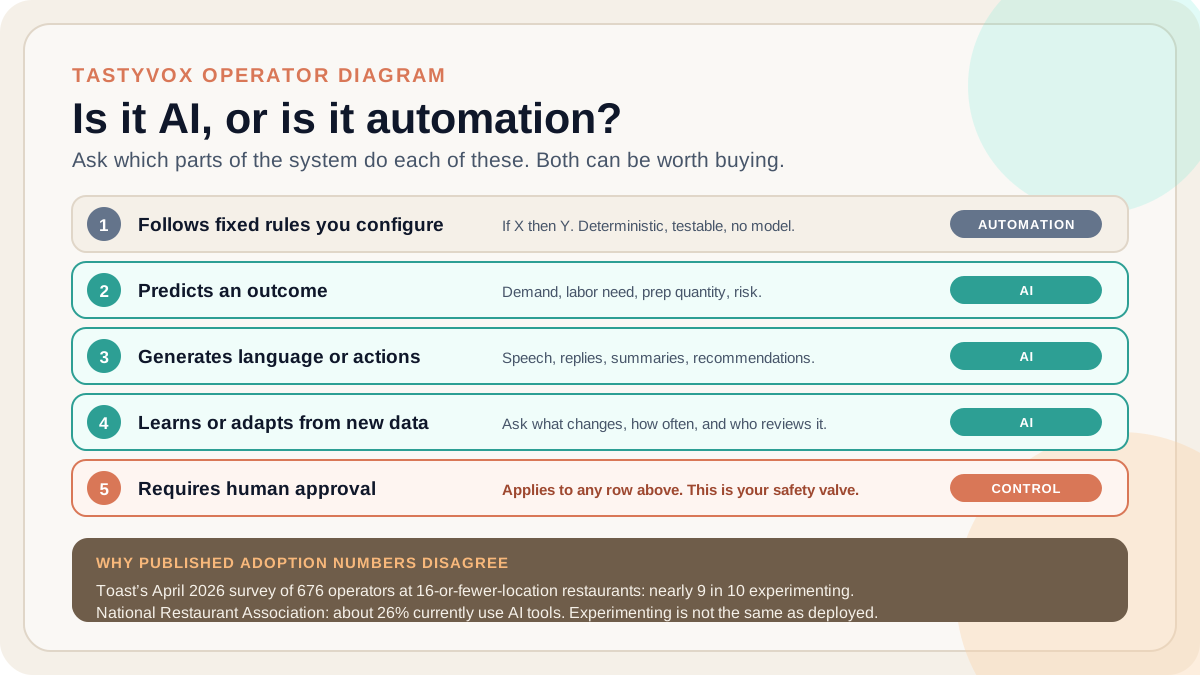
This also explains why published “AI adoption” numbers can look contradictory. Toast's April 2026 blind survey of 676 U.S. operators and decision-makers at restaurants with 16 or fewer locations, including Toast and non-Toast customers, reported that nearly nine in ten respondents were experimenting with AI. The National Restaurant Association separately reported that about 26% of operators currently use AI tools. Different samples, questions, and definitions can produce very different headlines, especially when one survey measures experimentation and another measures tools currently used in the operation.
When a vendor says “AI-powered,” ask for the operational verb. Does it forecast, classify, summarize, generate, recommend, or execute? If the answer is simply “it automates the workflow,” that may still be valuable. It is also a different claim.
3. Where does the system get its truth, and where does it write back?
Restaurant technology does not fail only because a model is weak. It fails because the menu, hours, modifiers, pricing, inventory, camera zones, labor rules, or customer records are incomplete or out of sync.
In my notes from the Building a Legacy Restaurant owner panel, Ian McCall discussed technology-stack and integration choices, including a move to GoTab. His larger point was communication: legacy depends on staff understanding the standards, the reason behind them, and how quality is communicated to guests without becoming a game of telephone.
AI adds another participant to that communication chain. The vendor should map it clearly:
System of record → AI reads approved data → AI recommends or acts → human reviews when required → result writes back → manager can audit what happened.
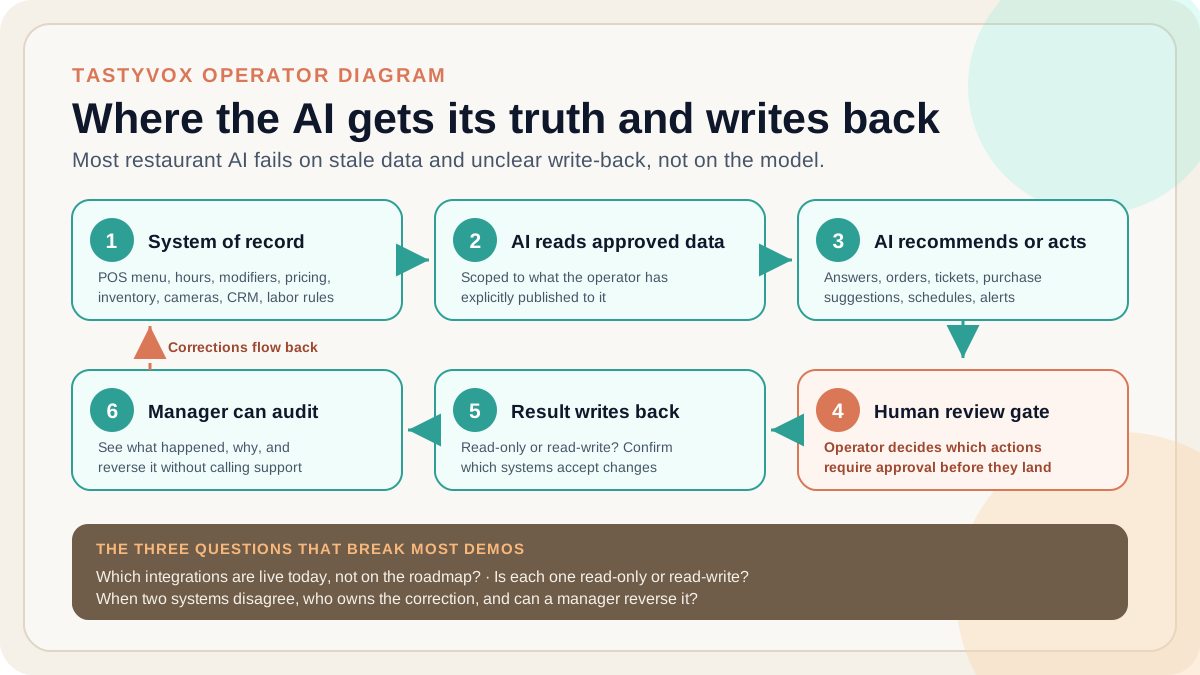
For voice AI, the source of truth may include the POS menu, reservation rules, hours, allergen language, and routing policies. For video AI, it may be camera streams, POS events, configured zones, and retention settings. For back-office tools, it can include sales, recipes, invoices, inventory, payroll, labor rules, and vendor catalogs.
The integration questions are simple but uncomfortable
- Which systems are truly integrated today, rather than simply “on the roadmap”?
- Is the connection read-only, or can the AI create orders, schedules, purchase orders, messages, or customer records?
- How quickly does changed information propagate?
- Who owns corrections when two systems disagree?
- Can a manager see an audit trail and reverse an action?
Deloitte's survey of 375 global restaurant executives found that fewer than half considered their organizations ready for AI across strategy, technology infrastructure, operations, governance, and talent. The readiness gaps are a reminder that integration and operating discipline usually matter more than the cleverest demo.
4. What happens when the AI is uncertain or wrong?
A restaurant does not need a flawless demo. It needs a safe failure mode.
For a phone system, start with the calls the restaurant actually receives: hours, directions, parking, menu availability, reservations, allergens, order status, private events, complaints, and after-hours questions. If the restaurant accepts phone orders, then add sold-out items, noisy callers, accents, mid-sentence changes, and ambiguous modifiers. A restaurant-specific voice system should use operator-configured outcomes such as a callback request, manager SMS, dashboard ticket, or live manager transfer when the operator chooses it.
For video AI, ask how false alerts are reviewed and how a manager changes camera zones or alert thresholds. For forecasting, ask what happens when weather, a local event, or a promotion makes historical demand unreliable. For a purchasing agent, ask what requires approval and what prevents an incorrect recommendation from becoming an actual order.
Mike Bausch's official session title captured the balance unusually well: “Restaurant Efficiency with AI Office Muscle and Analog Kitchen Grit.” The description paired AI for office productivity with simple kitchen tools such as whiteboards. The point was not to reject technology. It was to put each tool where it is most reliable.
Buying rule: Do not ask only what the AI can do. Ask what the restaurant can still do when the AI, integration, internet connection, or source data fails.
5. Which results are independently demonstrated, and which are vendor-reported?
Trade-show materials are designed to create interest. That is their job. A case-study percentage on a handout can be useful evidence, but it is not automatically a universal benchmark.
For every performance claim, ask for
- The denominator: how many restaurants, locations, calls, orders, or weeks were measured?
- The baseline: what was happening before the product was installed?
- The comparison: was the result year over year, before and after, or against a control group?
- The measurement owner: did the restaurant, vendor, POS, or an independent analyst calculate it?
- The exclusions: were failed locations, partial launches, or atypical periods removed?
- The operating context: QSR, full service, bar, venue, multi-unit group, or independent restaurant?
Vendor product descriptions and vendor case studies are two different kinds of evidence. Treat the first as a capability claim and the second as a result that still needs its methodology checked before using it as a benchmark.
6. What would a credible 30-day pilot measure?
A pilot should be small enough to diagnose and real enough to fail.
The cleanest sequence is
- Choose one costly workflow. Do not deploy across voice, marketing, labor, inventory, and video at once.
- Capture a pre-pilot baseline. Use at least the same dayparts and operating conditions you will measure during the pilot.
- Name the operator owner. A vendor cannot repair unclear restaurant policies from the outside.
- Test ugly edge cases. Use real rush-hour conditions, not only scripted demonstrations.
- Review weekly. Look at failures and staff workarounds, not just dashboard totals.
- Calculate total cost. Include setup, integration, hardware, training, staff review time, transaction fees, and support.
- Define the stop rule. Decide in advance what result means expand, revise, or cancel.
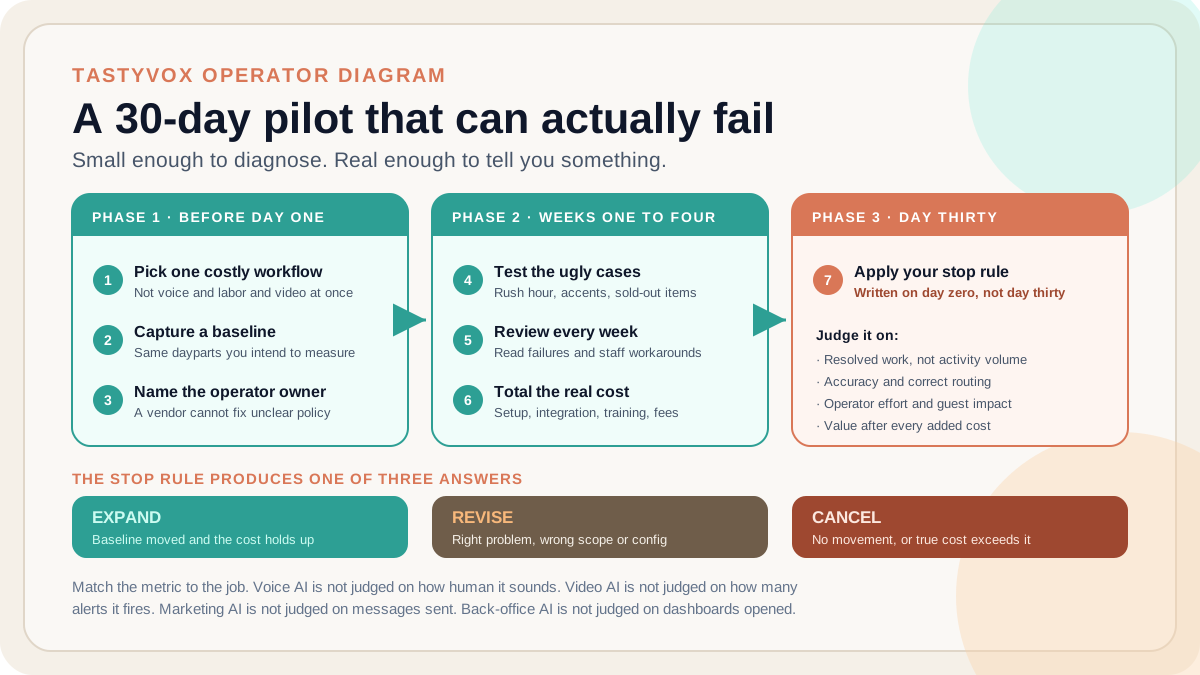
The pilot metric must match the job. Voice AI should not be judged only on how human it sounds. Video AI should not be judged by the number of alerts it creates. Marketing AI should not be judged by messages sent. Back-office AI should not be judged by dashboards opened.
Measure resolved work, accuracy, operator effort, guest impact, and the value created after every additional cost is counted.
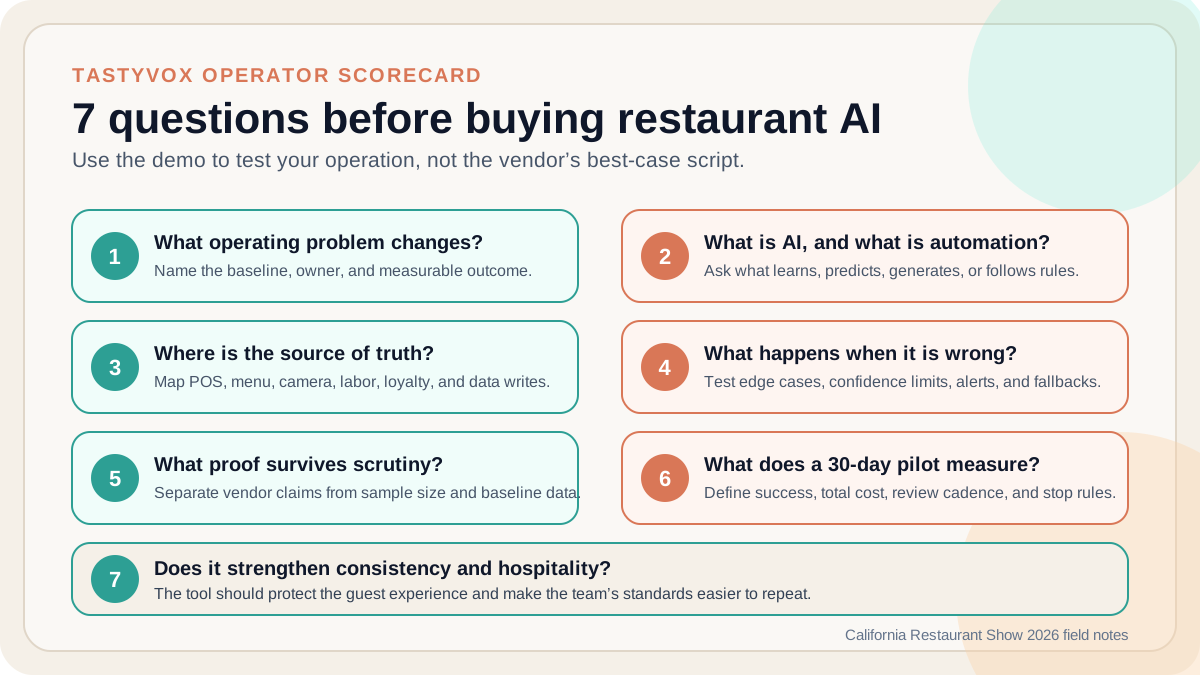
7. Does the technology strengthen consistency and hospitality?
The Building a Legacy Restaurant panel featured moderator Darren Denington with Troy Hooper of Pepper Lunch, Raul Gonzalez of Mariscos Choix, and Ian McCall of ISM Brewing & Kitchen. My notes from the session clustered around three ideas.
Consistency: Hooper emphasized systems, clear opportunities for employees, and backups when a process breaks. A legacy brand cannot depend on one exceptional manager remembering everything.
Communication: McCall returned to SOPs, the reasons behind the standards, and the way quality can degrade as instructions pass from person to person.
Care: Gonzalez framed hospitality as care rather than a transaction, alongside the need for an owner to step far enough outside daily service to see and improve the business.
The separate Restaurant Management 201 workshop reinforced the difference between leadership and management. My notes separated vision, mission, goals, and strategies: vision outlives the daily task list; leadership models the behavior; management makes the system repeatable through knowledge, decisions, communication, and accountability.
That is the final test for restaurant AI. The technology should make the restaurant's standards easier to repeat while leaving the team more available for judgment and care. If it creates a second source of truth, hides failures behind a dashboard, or makes guests work harder to reach a person when they truly need one, it has weakened hospitality even if the demo looked impressive.
Which vendors and ideas are worth following after the show?
The most useful follow-up list is not “best AI vendors.” It is a set of distinct operating questions:
- TryNearby: Can a structured local-creator workflow produce reusable, measurable content without adding excessive coordination work?
- Marble: Can an AI-native back-of-house layer reduce manual inventory, scheduling, purchasing, and reconciliation without creating a new disconnected system?
- KneesUp: Can venue-booking automation reduce the email, calendar, proposal, payment, and follow-up burden around private events?
- Curate: Can a restaurant own more of its ordering, loyalty, and customer data while measuring which marketing actions bring guests back?
- TastyVox: Can restaurant voice AI accurately answer routine questions and other operator-approved intents, integrate with the restaurant's systems, and route exceptions according to the operator's preferences?
- Solink: Can existing cameras and POS context reveal operational exceptions quickly enough to change a manager's day, rather than merely create more footage to review?
- Packaging and physical operations: Could a lower-tech change reduce cost, leakage, prep time, or guest friction more reliably than another software product?
The packaging question matters because the show was broader than AI. Restaurants do not earn points for using the most advanced tool. They earn results by choosing the right tool for the bottleneck.
What is the practical takeaway for restaurant operators?
The California Restaurant Show offered plenty of technology to explore, but the operator lesson was consistent across the AI booths, the legacy panel, Restaurant Management 201, and Mike Bausch's AI-and-whiteboard session.
Start with the work. Define the standard. Identify the source of truth. Test failure behavior. Demand evidence. Run a measured pilot. Protect hospitality.
Restaurant AI is already broad enough that the label alone tells an operator almost nothing. The seven questions above turn that label into an evaluation process and give a serious vendor a fair opportunity to prove what its system can actually do.
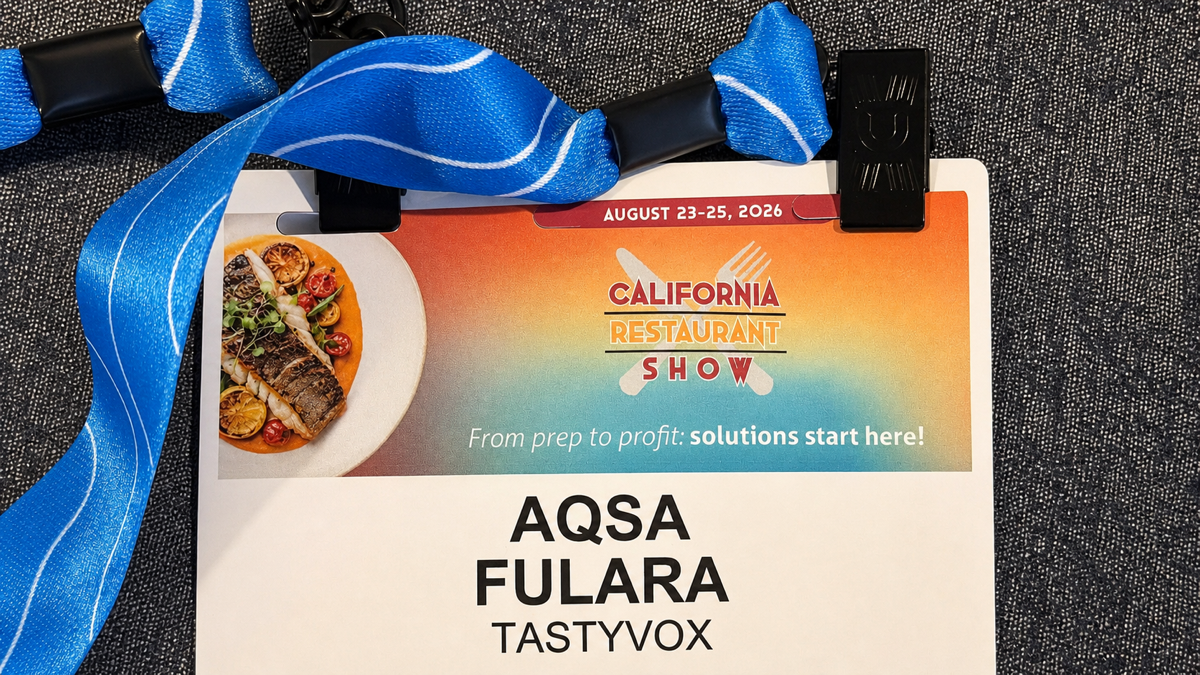
Alright, adieu, California Restaurant Show 2026. See you in 2027.
How this was researched
Based on Aqsa Fulara's firsthand attendance, vendor conversations, photographs, handouts, and contemporaneous session notes, checked against official event and session pages, vendor product pages, and published research from Toast, the National Restaurant Association, and Deloitte. Vendor capabilities are attributed to vendor-controlled sources. Session notes are paraphrased, not presented as verbatim quotations. No vendor paid for or sponsored inclusion.
Want to hear what this sounds like in practice?
Listen to a demo call with a real restaurant menu. No commitment, no sales pitch.
Frequently asked questions
What types of AI are restaurants using in 2026?
Restaurant AI includes voice assistance and guest intake, demand and labor forecasting, inventory counting, purchasing recommendations, video intelligence, customer segmentation, marketing assistance, and agent-style back-office workflows. Adoption figures vary depending on whether a survey counts general-purpose tools such as ChatGPT or only restaurant systems deployed in operations.
How should a restaurant evaluate an AI vendor?
Start with one operating problem and a measurable baseline. Then evaluate the vendor's data sources, integrations, edge-case handling, human controls, evidence, total cost, and a time-bounded pilot with defined success and stop criteria.
Is restaurant automation the same as restaurant AI?
No. Automation can follow fixed rules without prediction or generation. AI may classify, forecast, generate, recommend, or take actions based on data. Both can be useful, but they carry different accuracy, monitoring, and governance requirements.
What should a 30-day restaurant AI pilot measure?
Measure the outcome tied to the workflow: intent coverage, accurate answers, correct routing, and staff interruptions avoided for voice; alert precision and investigation time for video; forecast error and corrections for back office; attributable repeat visits for marketing; or response time and booking conversion for venue workflows. Include setup, integration, training, review time, and fees in the cost.
Which integrations matter most for restaurant AI?
It depends on the job. Common systems include the POS, digital menu, reservations, ordering, loyalty or CRM, cameras, scheduling, payroll, accounting, vendor catalogs, and messaging. Operators should ask whether each integration is live, read-only or read-write, how quickly data synchronizes, and who owns error correction.
Was the 2026 California Restaurant Show smaller than prior years?
Several attendees told TastyVox that the event felt smaller than its Los Angeles Convention Center years. A show-produced release said more than 7,000 professionals were registered and cited 340+ exhibit booths, while the official directory listed 274 exhibiting companies. Registrants, actual attendees, booths, and exhibiting companies are different measures, and a comparable post-show attendance total has not been published.
See how TastyVox sounds with your menu.
Book a 20-minute call and we'll walk through how it works for your specific restaurant.