
AI Phone Ordering for Venues: Menus, Modifiers, and Safe Exceptions
Key Takeaways
- Answering is not ordering. A natural conversation does not prove the system can construct a valid ticket.
- Menu truth is per channel and location. Daypart, tax, sold-out status, and modifier groups must match the source your team trusts.
- Modifiers are where demos break. Required choices, incompatible combinations, quantities, and upcharges need the same logic your POS uses.
- Confirmation must match what was written. Read-back, guest consent, and duplicate prevention are part of accuracy, not polish.
- Safe exceptions beat confident guesses. Allergens, policy limits, and failed writes should follow venue-approved escalation, not improvisation.
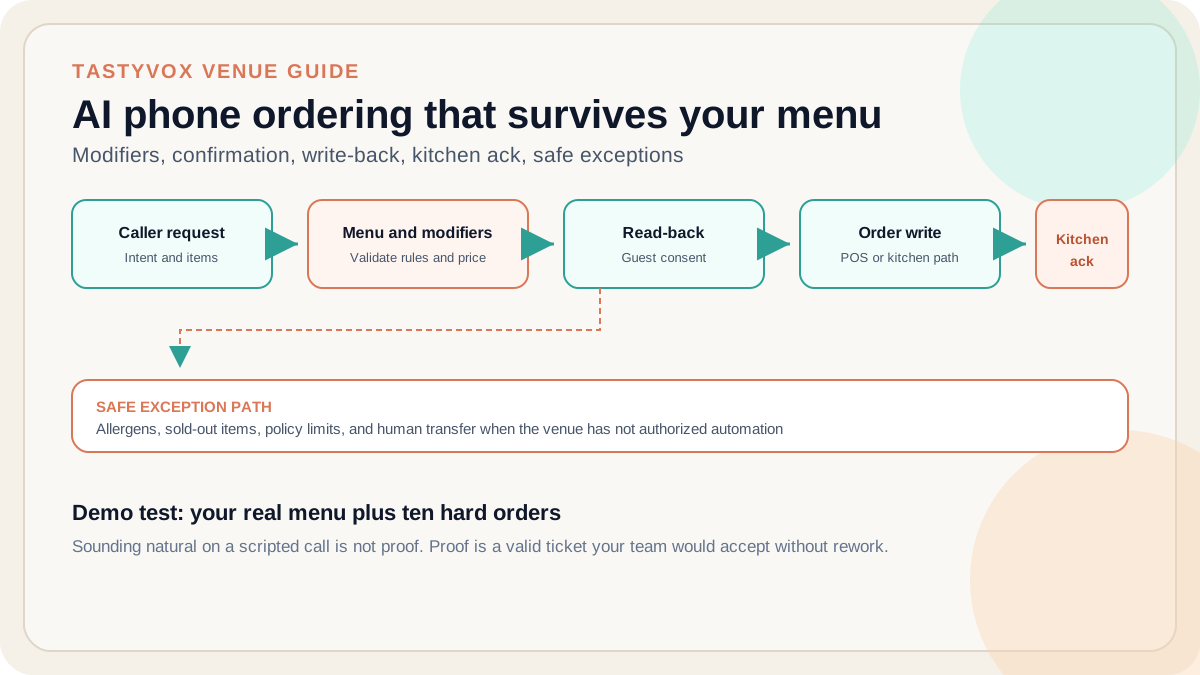
Why is constructing the order harder than answering the phone?
A voice demo can sound polished in five minutes and still fail the only test that matters on a Friday night: can it produce a ticket your kitchen would accept without rework?
Recognition is table stakes. The hard part of venue AI phone ordering is everything that happens after the guest finishes speaking. The system must read the right menu for the right location and channel, apply modifier rules that your POS enforces, confirm the cart in language the guest understands, write the order to the path your team actually monitors, and know when to stop guessing.
At TastyVox, we build voice AI for hospitality venues, so we have a commercial interest in this category. This guide is not a claim that every call should be automated. It is a practical framework for evaluating whether a phone-ordering workflow is safe enough to trust during service.
What makes phone ordering hard after the guest stops talking?
The guest has already done the easy part. They said what they want in messy human language, maybe changing their mind halfway through.
Your operation still has to
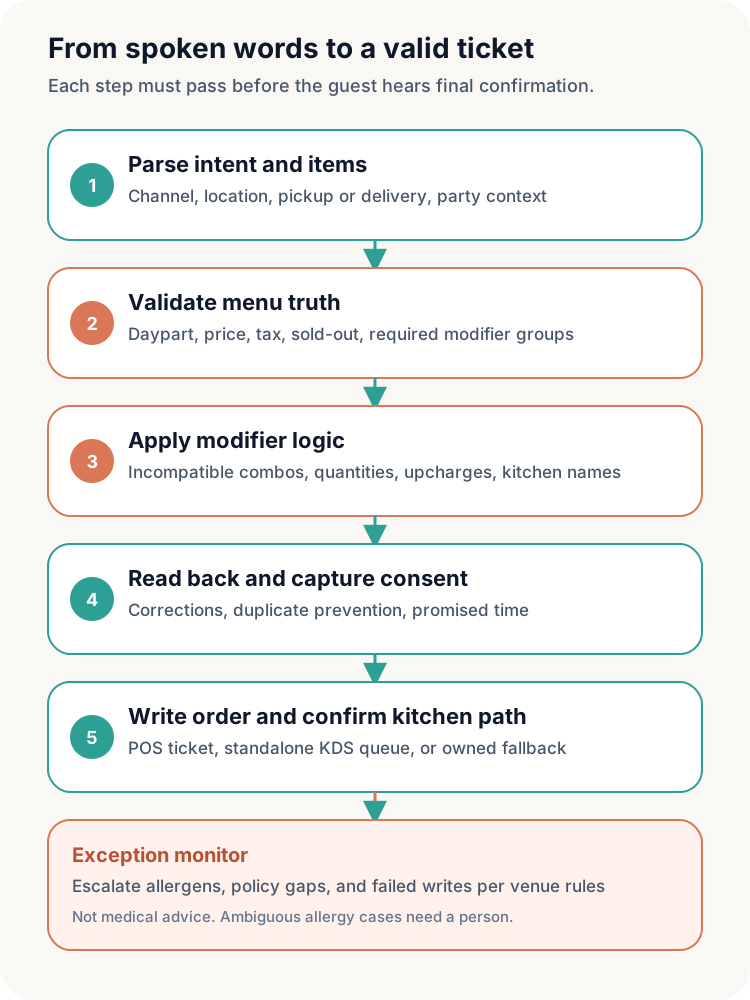
- Map spoken items to the correct SKU or kitchen name.
- Enforce required modifier groups and block illegal combinations.
- Price the cart with the right tax and channel rules.
- Confirm the details without rushing the guest.
- Create exactly one order on the path your kitchen watches.
- Detect when acknowledgement failed and respond before the guest leaves.
That sequence is why operators ask a sharper question than “Does it sound human?” They ask, “Can this system take a real order correctly, including substitutions, modifiers, sold-out items, and exceptions?”
Not every inbound call should become an automated order. Hours, directions, reservation changes, and complaint calls may need different outcomes. Scope the workflow before you score accuracy.
Where does menu truth come from?
Menu truth is the authorized answer for what may be sold, at what price, with which modifiers, at this location, on this channel, at this time of day.
Common failure modes
| Symptom | What usually broke | What to verify |
|---|---|---|
| Guest hears an item that kitchen cannot make | Stale or wrong channel menu | Ordering channel vs dine-in menu in POS |
| Price on the phone does not match the receipt | Tax, service charge, or location rules | Location-specific price books |
| “Available” item is sold out | Availability not synced | Update frequency and sold-out source |
| Special only valid at lunch | Daypart rules missing | Schedule-bound menus |
Our venue voice AI integrations guide explains how to assign a source of truth per data domain. For phone ordering, the menu owner is usually your POS or menu platform, not a marketing PDF.
Separate live production capability from guided setup, standalone kitchen queues, and roadmap integrations. A logo on a vendor page is not proof that your location’s modifier tree is connected today.
How should modifier logic behave on a phone order?
Modifiers are where polite conversation meets operational law.
Your POS already encodes rules the host learns on shift: required protein choice, max selections, incompatible toppings, half-and-half pizza logic, “no sub on special” policies, and upcharges that must appear before payment.
A useful phone-ordering test asks whether the voice workflow respects the same constraints:
- Required groups cannot be skipped because the guest rushed.
- Incompatible combinations trigger a clarifying question or a policy-backed decline.
- Quantities and portions map to the correct variation, not a nearby guess.
- Kitchen names on the ticket match what expo expects, even when the guest used casual language.
Official platform documentation from Square and Toast shows how complex catalog structures are in production systems. Your evaluation should mirror that complexity, not a flattened demo menu.
What belongs in confirmation and guest consent?
Confirmation is not theater. It is the last chance to prevent a remake.
A strong read-back includes item names the guest recognizes, modifiers that change preparation, allergy notes the venue has approved for capture, promised time or handoff method, and total or payment next step when your workflow includes them.
Also test duplicate prevention. Guests double-tap submit habits from apps. Callers repeat “and add fries” when nervous. Retry logic should not create twin tickets.
If the guest corrects the order, the system should reconcile the cart before write, not patch silently after the kitchen already started.
What does order write and kitchen acknowledgement require?
“Integrated” should mean something you can observe during service.
| Stage | Operator question | Failure signal |
|---|---|---|
| Write | Where does the ticket land? | Staff re-keying from a text summary |
| Identity | Is there a stable order ID? | Cannot match guest callback to a ticket |
| Routing | Does it hit the right station? | Cold items on hot line |
| Acknowledgement | How do you know the kitchen saw it? | Guest told “all set” with no production start |
| Recovery | What happens on write failure? | Silent drop or duplicate retry |
Some venues launch with a standalone kitchen display workflow that is honest about separation from native POS integration. That can work when the team knows who monitors the queue and how tickets are reconciled. It should not be marketed as full POS automation if it is not.
See how a GoTab-connected venue approached production phone ordering in our case study. Names and metrics stay anonymized where required; the lesson is the operating path, not a universal benchmark.
When should the system refuse automation and escalate?
Safe exceptions protect guests and staff.
Escalate or transfer when
- Allergy or cross-contact risk is ambiguous. Ingredient information is not medical advice. If the venue has not approved a definitive answer, a person should verify.
- Policy requires human authority, such as large comps, unusual substitutions, or alcohol rules.
- Inventory is uncertain and guessing would strand the kitchen.
- The guest is upset or the call is no longer a standard order flow.
- Write or acknowledgement failed and the guest would otherwise leave believing the order is in progress.
Our transfer-to-human guide covers cold, warm, and screened handoffs, including the unanswered path when nobody picks up.
What is the ten-order demo test?
Bring your real menu and ten deliberately difficult orders. Score each pass or fail on ticket validity, not voice quality.
Example stress cases operators use
- Two items with conflicting modifier requirements in one sentence.
- Half-and-half or split customization.
- Sold-out item mid-order with a substitute policy.
- Allergy note plus a follow-up question the menu cannot answer safely.
- Change mind after read-back.
- Duplicate phrasing that could create two lines of the same item.
- Daypart item ordered two minutes before the switch.
- Location-specific price or tax difference.
- Large family bundle with nested optional groups.
- Payment or pickup-time edge case your policy handles manually today.
If the vendor cannot run these on your data model, treat that as a scope limit, not a hidden launch detail.
Operator checklist before you trust phone ordering in production
- [ ] Menu owner, update frequency, and sold-out source documented.
- [ ] Modifier groups tested against POS rules, not a simplified spreadsheet.
- [ ] Confirmation script approved by the GM or chef.
- [ ] Write path named with a human monitor during peak.
- [ ] Acknowledgement signal defined (KDS bump, POS status, or explicit callback rule).
- [ ] Exception and transfer policies written, including unanswered handoff.
- [ ] Staff trained on what the assistant may and may not promise.
- [ ] Weekly review of failed writes, remakes tied to phone orders, and repeat callers.
For broader vendor questions, pair this checklist with our complete venue phone AI guide.
Summary
Reliable AI phone ordering for venues is an operating problem dressed as a conversation. Menu truth, modifier logic, confirmation, write-back, kitchen acknowledgement, and safe exceptions each need an owner. Test with your real menu and ugly orders, separate live integrations from roadmap claims, and treat human transfer as success when policy requires it.
Ask TastyVox to test your venue’s real menu and exception rules at a scoped demo. We will map what is live today, what needs a standalone launch path, and where your team should stay in the loop.
How this was researched
This article combines operator evaluation practice with official Square and Toast menu API documentation for background on catalog complexity. Platform docs describe vendor capabilities, not TastyVox deployment depth for a specific venue. Current TastyVox integration status should be confirmed on `/integrations` before purchase decisions.
Want to hear what this sounds like in practice?
Listen to a demo call with a real restaurant menu. No commitment, no sales pitch.
Frequently asked questions
Does natural-sounding voice mean the order will be accurate?
No. Accuracy depends on menu data, modifier enforcement, confirmation, and write acknowledgement. Voice quality helps guest patience, but it does not replace catalog truth.
Should every phone call become an automated order?
No. Match automation to call intent. Many venues automate routine takeout while routing complaints, complex catering, and ambiguous allergy questions to staff.
Can we launch without full POS integration?
Sometimes. A standalone kitchen queue or guided workflow can be valid if described honestly, monitored during service, and reconciled with POS. Ask what breaks when the connection fails.
How often should menu data update?
Often enough that sold-out items and price changes during service are reflected before guests hear confirmation. Define the update path and who fixes sync errors.
What if the guest has an allergy?
Capture the note if policy allows, but do not treat the assistant as a clinician. When preparation risk is unclear, escalate using the venue’s approved script.
How do we know the kitchen received the order?
Define an acknowledgement signal your team trusts: KDS fire, POS status, expo confirmation, or a callback rule. “Thank you, goodbye” is not acknowledgement.
See how TastyVox sounds with your menu.
Book a 20-minute call and we'll walk through how it works for your specific restaurant.