
Venue Voice AI Pilot Scorecard: A 30-Day Test Plan
Key Takeaways
- Define one workflow and a baseline before launch. Measuring everything at once hides failure.
- Every rate needs a denominator. “Orders completed” is meaningless without eligible ordering calls.
- Containment is not resolution. A call can avoid transfer and still fail the guest.
- Count staff rework. Corrections, callbacks, refunds, and manual re-entry belong in the scorecard.
- Write expand, revise, and stop rules on day zero. Decision criteria should not be invented after a disappointing week three.
What should a venue measure before expanding voice AI?
Voice AI pilots fail quietly when teams celebrate activity instead of outcomes. The dashboard shows hundreds of handled calls while hosts still re-key tickets, guests call back twice, and managers discover duplicate orders at the pass.
A credible venue voice AI pilot is small enough to diagnose and real enough to fail. It produces an expand, revise, or stop decision based on measurements your GM would defend in a staff meeting, not vanity metrics a vendor slides into a recap deck.
At TastyVox, we sell voice AI for hospitality venues. This scorecard is our operating template for scoped pilots with agreed baselines. It extends ideas from field conversations and from the seven-question evaluation frame in our California Restaurant Show 2026 recap, but it is written as a standalone test plan with definitions you can adopt without rereading that article.
Why do most voice AI pilots measure the wrong things?
Vendors default to metrics that rise when the product is plugged in: call volume, minutes saved, containment rate, sentiment scores.
Operators need metrics tied to resolved venue work
- Did the guest get the right outcome without unnecessary repeat contact?
- Did the ticket match what the kitchen produced?
- Did staff spend less time fixing phone mistakes during peak?
- Did total cost, including review time, stay inside the range you modeled?
Do not treat an unanswered call as a lost order by default. Your call log intent mix may include hours, directions, and status checks. Score the workflow you chose to automate.
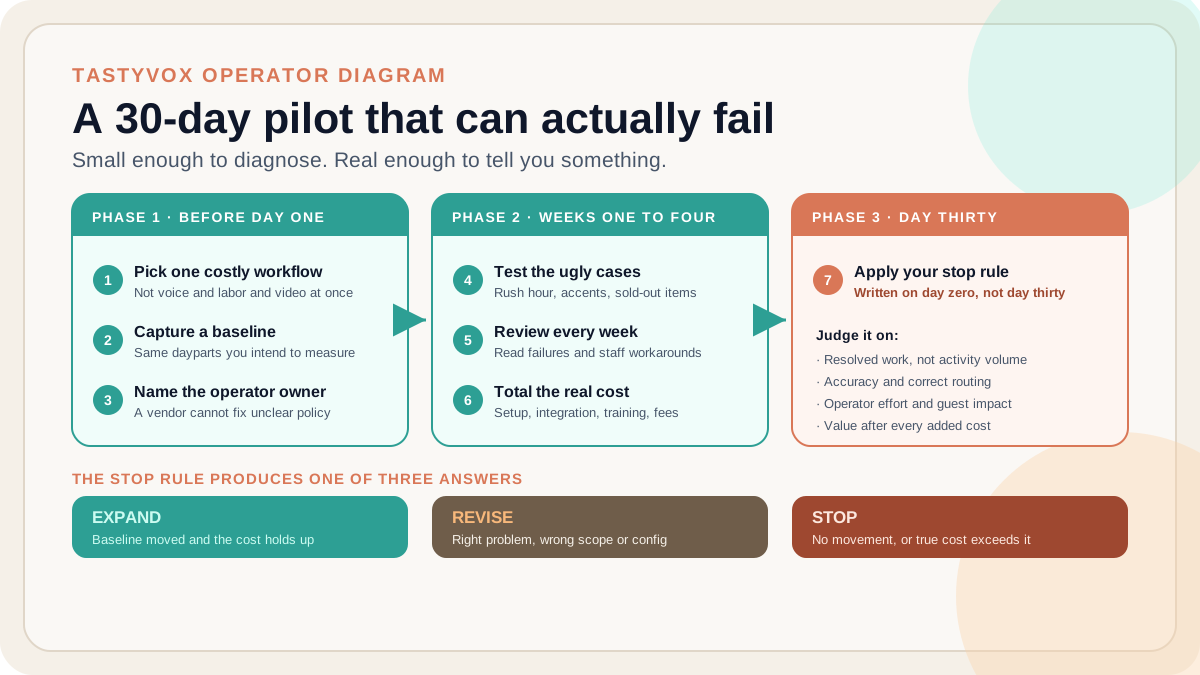
Week 0: policies, ownership, test cases, costs, and stop rules
Before day one of live traffic, complete setup that vendors cannot do for you.
| Workstream | Owner (venue role) | Deliverable |
|---|---|---|
| Workflow scope | GM or ops lead | One primary job, e.g., takeout order capture on line 1 |
| Baseline window | Ops + finance | Two comparable weeks of call intent notes or tagged samples |
| Policies | GM + chef | Allergy escalation, comp limits, transfer triggers |
| Test cases | FOH manager | Ten ugly orders and five non-order calls |
| Cost model | Owner or controller | Setup, subscription, usage, integration, training, review hours |
| Stop rule | Owner | Pre-written expand, revise, stop thresholds |
Baseline capture should use the same dayparts you plan to automate. If you will run Friday dinner, do not baseline Tuesday lunch only.
Stop rules example format (customize, do not copy blindly):
- Expand if successful resolution on eligible calls improves by a band you define, critical failures stay below your cap, and full cost per resolved outcome beats baseline staff effort.
- Revise if guests are helped but menu scope, hours, or integration depth was wrong.
- Stop if critical failures exceed cap, staff rework rises, or total cost exceeds your modeled range without offsetting value.
Week 1: routing, menu truth, transfers, and critical failures
Focus: does the plumbing work under light load?
Review daily
- Routing accuracy: Did calls reach the intended workflow?
- Menu truth errors: Wrong item, price, or modifier on first write.
- Transfer quality: Did escalations include context? Did unanswered transfers follow your human handoff plan?
- Critical failures: Duplicate charge risk, allergy mishandling, orders written with no kitchen path, or guests told success when write failed.
Log each critical failure with ticket ID, time, and fix owner. Averages hide the incidents that would become a social review.
Week 2: resolution quality, guest effort, and staff rework
Focus: are you reducing work or moving it?
| Metric | Definition | Denominator |
|---|---|---|
| Successful resolution | Guest need closed without repeat contact for same issue | Eligible calls in scope |
| First-contact resolution | Resolved on initial call | Eligible calls |
| Guest repeat contact | Callback or return call within 24 hours for same order issue | Orders placed via voice |
| Staff correction rate | Tickets edited by staff after voice write | Voice-written tickets |
| Manual re-entry rate | Orders typed again into POS | Voice-written tickets |
Interview hosts briefly. Workarounds show up in behavior before they show up in dashboards.
Week 3: peak behavior, exceptions, and integration reliability
Focus: Friday night, not Tuesday afternoon.
- Run your ten hard menu cases during rush if safe for guests.
- Track integration uptime and write failures separately from conversational confusion.
- Measure exception path usage: allergens, sold-out substitutions, policy declines.
- Compare queue time to human when transfers spike. Did service on the floor suffer?
Pair operational review with the menu and modifier standards in our phone ordering accuracy guide.
Week 4: total cost, failure review, and rollout decision
Close the month with finance and floor leads in the same room.
Full cost includes:
- Vendor setup and subscription
- Usage or per-minute fees
- Integration services
- Hardware or tablet costs if applicable
- Training and change-management time
- Manager and staff review time during the pilot
- Payment processing differences if workflows changed
Use ranges when attribution is uncertain. Do not invent a single ROI percentage to justify expansion.
Hold a failure review before the decision meeting. Categories: menu data, modifier logic, confirmation, write failures, transfer gaps, guest confusion, and policy gaps.
Apply the stop rule you wrote on day zero.
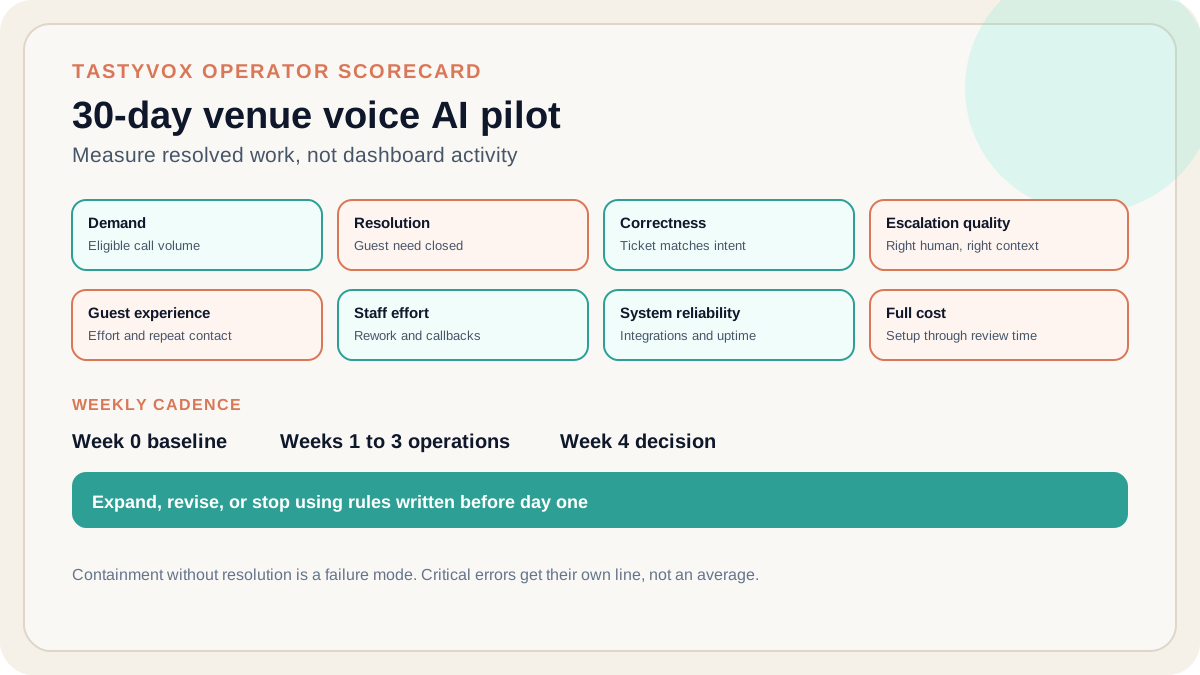
Scorecard dimensions at a glance
| Dimension | What it answers | Example signal |
|---|---|---|
| Demand | Was there enough eligible volume to learn? | Eligible calls per daypart |
| Resolution | Did guests get the outcome they called for? | Successful resolution rate |
| Correctness | Did tickets match intent? | Remake or refund linkage |
| Escalation quality | Did humans get context? | Repeat explanation rate |
| Guest experience | Was effort reasonable? | Repeat contact, hold time |
| Staff effort | Did floor work shrink? | Corrections per 100 voice orders |
| System reliability | Did integrations hold? | Write failure rate, uptime |
| Full cost | Is the workflow worth scaling? | Cost per resolved outcome band |
Report critical failures on their own line. Never bury them inside a cheerful average.
Expand, revise, or stop: decision table
| Signal pattern | Likely decision | Next action |
|---|---|---|
| Resolution up, corrections down, critical failures rare | Expand | Add daypart, location, or second workflow |
| Guests helped but menu scope too narrow | Revise | Reload catalog, retrain policies, retest ten hard orders |
| Write failures or transfer gaps persist | Revise | Fix integration path or change launch scope |
| Staff rework up or guest repeat contact up | Revise or stop | Inspect confirmation and acknowledgement |
| Critical failures above cap | Stop | Disable automated write until root cause fixed |
| Full cost above range with no offsetting value | Stop | Revisit whether the workflow was the right first job |
How does this relate to the seven-question vendor checklist?
The seven questions from our California Restaurant Show field report help you buy responsibly: operating problem, AI vs automation, source of truth, failure behavior, proof, pilot metrics, and hospitality impact.
This scorecard helps you run the pilot those questions imply. Use both together: questions during vendor selection, definitions and cadence during the thirty days.
Summary
A venue voice AI pilot should end with a clear decision, not an open-ended subscription. Define baselines, denominators, weekly reviews, eight dimensions, and stop rules before go-live. Measure resolution and rework, separate containment from success, and count full cost honestly.
Run a scoped TastyVox pilot with agreed baselines, policies, and decision criteria. Book a working session to align on workflow, integration path, and the ten-order test before you point live traffic at the assistant.
How this was researched
Measurement definitions and cadence are original TastyVox operator guidance. They align with themes from the California Restaurant Show 2026 article but add weekly structure, denominators, rework metrics, and an expand/revise/stop table. No private customer metrics or transcripts are used.
Want to hear what this sounds like in practice?
Listen to a demo call with a real restaurant menu. No commitment, no sales pitch.
Frequently asked questions
How long should a voice AI pilot run?
Thirty days is enough when the workflow is narrow, baselines exist, and you review weekly. Shorter windows often capture only calm shifts.
What is a critical failure?
Any incident that could cause guest harm, significant financial loss, or a ticket the kitchen should not have received. Track these separately from minor phrasing issues.
Should we pilot on one location only?
Usually yes for multi-unit groups. Compare locations only after each has comparable call mix and menu complexity.
What if call volume is low during the pilot?
Extend the window or narrow claims. Low denominators make rates unstable.
Can we pilot phone answering without order write?
Yes. Match metrics to scope. An FAQ-only pilot should not be judged on kitchen acknowledgement.
Do we need POS integration on day one?
Not always. Standalone kitchen workflows can be valid if monitored and described honestly. See our [integrations guide](/blog/restaurant-voice-ai-integrations-pos-kds) for launch paths.
See how TastyVox sounds with your menu.
Book a 20-minute call and we'll walk through how it works for your specific restaurant.